Remembering the past and recognizing the limits of science …

A recent article in the Guardian reports on a debate at University College London (1) on whether to rename buildings because the people honored harbored odious ideological and political positions. Similar debates and decisions, in some cases involving unacceptable and abusive behaviors rather than ideological positions, have occurred at a number of institutions (see Calhoun at Yale, Sackler in NYC, James Watson at Cold Spring Harbor, Tim Hunt at the MRC, and sexual predators within the National Academy of Sciences). These debates raise important and sometimes troubling issues.

When a building is named after a scientist, it is generally in order to honor that person’s scientific contributions. The scientist’s ideological opinions are rarely considered explicitly, although they may influence the decision at the time.  In general, scientific contributions are timeless in that they represent important steps in the evolution of a discipline, often by establishing a key observation, idea, or conceptual framework upon which subsequent progress is based – they are historically important.  In this sense, whether a scientific contribution was correct (as we currently understand the natural world) is less critical than what that contribution led to. The contribution marks a milestone or a turning point in a discipline, understanding that the efforts of many underlie disciplinary progress and that those contributors made it possible for others to “see further.” (2)

Since science is not about recognizing or establishing a single unchanging capital-T-Truth, but rather about developing an increasingly accurate model for how the world works, it is constantly evolving and open to revision.  Working scientists are not particularly upset when new observations lead to revisions to or the abandonment of ideas or the addition of new terms to equations.(3)

Compare that to the situation in the ideological, political, or religious realms.  A new translation or interpretation of a sacred text can provoke schism and remarkably violent responses between respective groups of believers. The closer the groups are to one another, the more horrific the levels of violence that emerge often are.  In contrast, over the long term, scientific schools of thought resolve, often merging with one another to form unified disciplines. From my own perspective, and not withstanding the temptation to generate new sub-disciplines (in part in response to funding factors), all of the life sciences have collapsed into a unified evolutionary/molecular framework.  All scientific disciplines tend to become, over time, consistent with, although not necessarily deducible from, one another, particularly when the discipline respects and retains connections to the real (observable) world.(4)  How different from the political and ideological.

The historical progression of scientific ideas is dramatically different from that of political, religious, or social mores.  No matter what some might claim, the modern quantum mechanical view of the atom bears little meaningful similarity to the ideas of the cohort that included Leucippus and Democritus.  There is progress in science.  In contrast, various belief systems rarely abandon their basic premises.  A politically right- or left-wing ideologue might well find kindred spirits in the ancient world.  There were genocidal racists, theists, and nationalists in the past and there are genocidal racists, theists, and nationalists now.  There were (limited) democracies then, as there are (limited) democracies now; monarchical, oligarchical, and dictatorial political systems then and now; theistic religions then and now. Absolutist ideals of innate human rights, then as now, are routinely sacrificed for a range of mostly self-serving or politically expedient reasons.  Advocates of rule by the people repeatedly install repressive dictatorships. The authors of the United States Constitution declare the sacredness of human rights and then legitimized slavery. “The Bible … posits universal brotherhood, then tells Israel to kill all the Amorites.” (Phil Christman). The eugenic movement is a good example; for the promise of a genetically perfect future, existing people are treated inhumanely – just another version of apocalyptic (ends justify the means) thinking. 

Ignoring the simpler case of not honoring criminals (sexual and otherwise), most calls for removing names from buildings are based on the odious ideological positions espoused by the honored – typically some version of racist, nationalistic, or sexist ideologies.  The complication comes from the fact that people are complex, shaped by the context within which they grow up, their personal histories and the dominant ideological milieu they experienced, as well as their reactions to it.  But these ideological positions are not scientific, although a person’s scientific worldview and their ideological positions may be intertwined. The honoree may claim that science “says” something unambiguous and unarguable, often in an attempt to force others to acquiesce to their perspective.  A modern example would be arguments about whether climate is changing due to anthropogenic factors, a scientific topic, and what to do about it, an economic, political, and perhaps ideological question.(5)

So what to do?  To me, the answer seems reasonably obvious – assuming that the person’s contribution was significant enough, we should leave the name in place and use the controversy to consider why they held their objectionable beliefs and more explicitly why they were wrong to claim scientific justification for their ideological (racist / nationalist / sexist / socially prejudiced) positions.(6)  Consider explicitly why an archeologist (Flinders Petrie), a naturalist (Francis Galton), a statistician (Karl Pearson), and an advocate for women’s reproductive rights (Marie Stopes) might all support the non-scientific ideology of eugenics and forced sterilization.  We can use such situations as a framework within which to delineate the boundaries between the scientific and the ideological. 

Understanding this distinction is critical and is one of the primary justifications for why people not necessarily interested in science or science-based careers are often required to take science courses.  Yet all too often these courses fail to address the constraints of science, the difference between political and ideological opinions, and the implications of scientific models.  I would argue that unless students (and citizens) come to understand what constitutes a scientific idea or conclusion and what reflects a political or ideological position couched in scientific or pseudo-scientific terms, they are not learning what they need to know about science or its place in society.  That science is used as a proxy for Truth writ large is deeply misguided. It is much more important to understand how science works than it is to remember the number of phyla or the names of amino acids, the ability to calculate the pH of a solution, or to understand processes going on at the center of a galaxy or the details of a black hole’s behavior.  While sometimes harmless, misunderstanding science and how it is used socially can result in traumatic social implications, such as drawing harmful conclusions about individuals from statistical generalizations of populations, avoidable deaths from measles, and the forced “eugenic” sterilization of people deemed defective.  We should seek out and embrace opportunities to teach about these issues, even if it means we name buildings after imperfect people.  

footnotes:

  1. The location of some of my post-doc work.
  2. In the words of Isaac Newton, “If I have seen further than others, it is by standing upon the shoulders of giants.”
  3.  Unless, of course, the ideas and equations being revised or abandoned are one’s own. 
  4.  Perhaps the most striking exception occurs in physics on the subjects of quantum mechanics and relativity, but as I am not a physicist, I am not sure about that. 
  5.  Perhaps people are “meant” to go extinct. 
  6.  The situation is rather different outside of science, because the reality of progress is more problematic and past battles continue to be refought.  Given the history of Reconstruction and the Confederate “Lost Cause” movement [see PBS’s Reconstruction] following the American Civil War, monuments to defenders of slavery, no matter how admirable they may have been in terms of personal bravery and such, reek of implied violence, subjugation, and repression, particularly when the person honored went on to found an institution dedicated to racial hatred and violent intimidation [link]. There would seem little doubt that a monument in honor of a Nazi needs to be eliminated and replaced by one to their victims or to those who defeated them.

Is it possible to teach evolutionary biology “sensitively”?

Michael Reiss, a professor of science education at University College London and an Anglican Priest, suggests that “we need to rethink the way we teach evolution” largely because conventional approaches can be unduly confrontational and “force religious children to choose between their faith and evolution” or to result in students who”refuse to engage with a lesson.” He suggests that a better strategy would be akin to those use to teach a range of “sensitive” subjects “such as sex, pornography, ethnicity, religion, death studies, terrorism, and others” and could “help some students to consider evolution as a possibility who would otherwise not do so.” [link to his original essay and a previous post on teaching evolution: Go ahead and teach the controversy].

There is no doubt that an effective teacher attempts to present materials sensitively; it is the rare person who will listen to someone who “teaches” ideas in a hostile, alienating, or condescending manner. That said, it can be difficult to avoid the disturbing implications of scientific ideas, implications that can be a barrier to their acceptance. The scientific conclusion that males and females are different but basically the same can upset people on various sides of the theo-political spectrum. 

In point of fact an effective teacher, a teacher who encourages students to question their long held, or perhaps better put, familial or community beliefs, can cause serious social push-back  – Trouble with a capital T.  It is difficult to imagine a more effective teacher than Socrates (~470-399 BCE). Socrates “was found guilty of ‘impiety’ and ‘corrupting the young’, sentenced to death” in part because he was an effective teacher (see Socrates was guilty as charged).  In a religious and political context, challenging accepted Truths (again with a capital T) can be a crime.  In Socrates’ case”Athenians probably genuinely felt that undesirables in their midst had offended Zeus and his fellow deities,” and that, “Socrates, an unconventional thinker who questioned the legitimacy and authority of many of the accepted gods, fitted that bill.”  

So we need to ask of scientists and science instructors, does the presentation of a scientific, that is, a naturalistic and non-supernatural, perspective in and of itself represent an insensitivity to those with a super-natural belief system. Here it is worth noting a point made by the philosopher John Gray, that such systems extend beyond those based on a belief in god(s); they include those who believe, with apocalyptic certainty, in any of a number of Truths, ranging from the triumph of a master race, the forced sterilization of the unfit, the dictatorship of the proletariat, to history’s end in a glorious capitalist and technological utopia. Is a science or science instruction that is “sensitive” to, that is, uncritical of or upsetting to those who hold such beliefs, possible? 

My original impression is that one’s answer to this question is likely to be determined by whether one considers science a path to Truth, with a purposeful capital T, or rather that the goal of scientists is to build a working understanding of the world around and within us.  Working scientists, and particularly biologists who must daily confront the implications of apparently un-intelligent designed organisms (due to ways evolution works) are well aware that absolute certainty is counterproductive. Nevertheless, the proven explanatory and technological power of the scientific enterprise cannot help but reinforce the strong impression that there is some deep link between scientific ideas and the way the world really works.  And while some scientists have advocated unscientific speculations (think multiverses and cosmic consciousness), the truth, with a small t, of scientific thinking is all around us.  

Photograph of the Milky Way by Tim Carl photography, used by permission 

 A science-based appreciation of the unimaginable size and age of the universe, taken together with compelling evidence for the relatively recent appearance of humans (Homo sapiens from their metazoan, vertebrate, tetrapod, mammalian, and primate ancestors) cannot help but impact our thinking as to our significance in the grand scheme of things (assuming that there is such a, possibly ineffable, plan)(1). The demonstrably random processes of mutation and the generally ruthless logic by which organisms survive, reproduce, and evolve, can lead even the most optimistic to question whether existence has any real meaning.  

Consider, as an example, the potential implications of the progress being made in terms of computer-based artificial intelligence, together with advances in our understanding of the molecular and cellular connection networks that underlie human consciousness and self-consciousness. It is a small step to conclude, implicitly or explicitly, that humans (and all other organisms with a nervous system) are “just” wet machines that can (and perhaps should) be controlled and manipulated. The premise, the “self-evident truth”, that humans should be valued in and of themselves, and that their rights should be respected (2) is eroded by the ability of machines to perform what were previously thought to be exclusively human behaviors. 

Humans and their societies have, after all, been around for only a few tens of thousands of years.  During this time, human social organizations have passed from small wandering bands influenced by evolutionary kin and group selection processes to produce various social systems, ranging from more or less functional democracies, pseudo-democracies (including our own growing plutocracy), dictatorships, some religion-based, and totalitarian police states.  Whether humans have a long term future (compared to the millions of years that dinosaurs dominated life on Earth) remains to be seen – although we can be reasonably sure that the Earth, and many of its non-human inhabitants, will continue to exist and evolve for millions to billions of years, at least until the Sun explodes. 

So how do we teach scientific conclusions and their empirical foundations, which combine to argue that science represents how the world really works, without upsetting the most religiously and politically fanatical among us?  Those who most vehemently reject scientific thinking because they are the most threatened by its apparently unavoidable implications. The answer is open to debate, but to my mind it involves teaching students (and encouraging the public) to distinguish empirically-based, and so inherently limited observations and the logical, coherent, and testable scientific models they give rise to from unquestionable TRUTH- and revelation-based belief systems. Perhaps we need to focus explicitly on the value of science rather than its “Truth”. To reinforce what science is ultimately for; what justifies society’s support for it, namely to help reduce human suffering and (where it makes sense) to enhance the human experience, goals anchored in the perhaps logically unjustifiable, but nevertheless essential acceptance of the inherent value of each person.   

  1. Apologies to “Good Omens”
  2. For example, “We hold these truths to be self-evident, that all men are created equal, that they are endowed by their creator with certain unalienable rights, that among these are life, liberty and the pursuit of happiness.” 

Science “awareness” versus “literacy” and why it matters, politically.

Montaigne concludes, like Socrates, that ignorance aware of itself is the only true knowledge”  – from “forbidden knowledge” by Roger Shattuck

A month or so ago we were treated to a flurry of media excitement surrounding the release of the latest Pew Research survey on Americans’ scientific knowledge.  The results of such surveys have been interpreted to mean many things. As an example, the title of Maggie Koerth-Baker’s short essay for the 538 web site was a surprising “Americans are Smart about Science”, a conclusion not universally accepted (see also).  Koerth-Baker was taken by the observation that the survey’s results support a conclusion that Americans’ display “pretty decent scientific literacy”.  Other studies (see Drummond & Fischhoff 2017) report that one’s ability to recognize scientifically established statements does not necessarily correlate with the acceptance of science policies – on average climate change “deniers” scored as well on the survey as “acceptors”.  In this light, it is worth noting that science-based policy pronouncements generally involve projections of what the future will bring, rather than what exactly is happening now.  Perhaps more surprisingly, greater “science literacy” correlates with more polarized beliefs that, given the tentative nature of scientific understanding –which is not about truth per se but practical knowledge–suggests that the surveys’ measure something other than scientific literacy.  While I have written on the subject before  it seems worth revisiting – particularly since since then I have read Rosling’s FactFullness and thought more about the apocalyptic bases of many secular and religious movements, described in detail by the historian Norman Cohn and the philosopher John Gray and gained a few, I hope, potentially useful insights on the matter.  

First, to understand what the survey reports we should take a look at the questions asked and decide what the ability to chose correctly implies about scientific literacy, as generally claimed, or something simpler – perhaps familiarity.  It is worth recognizing that all such instruments, particularly  those that are multiple choice in format, are proxies for a more detailed, time consuming, and costly Socratic interrogation designed to probe the depth of a persons’ knowledge and understanding.  In the Pew (and most other such surveys) choosing the correct response implies familiarity with various topics impacted by scientific observations. They do not necessarily reveal whether or not the respondent understands where the ideas come from, why they are the preferred response, or exactly where and when they are relevant (2). So is “getting the questions correct” demonstrates a familiarity with the language of science and some basic observations and principles but not the limits of respondents’ understanding.  

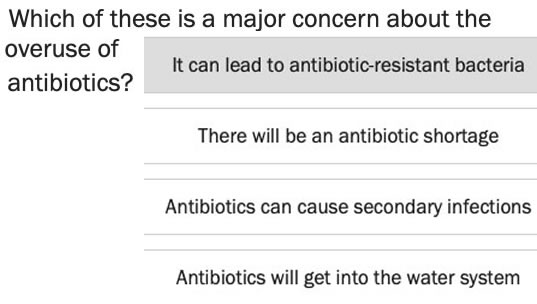
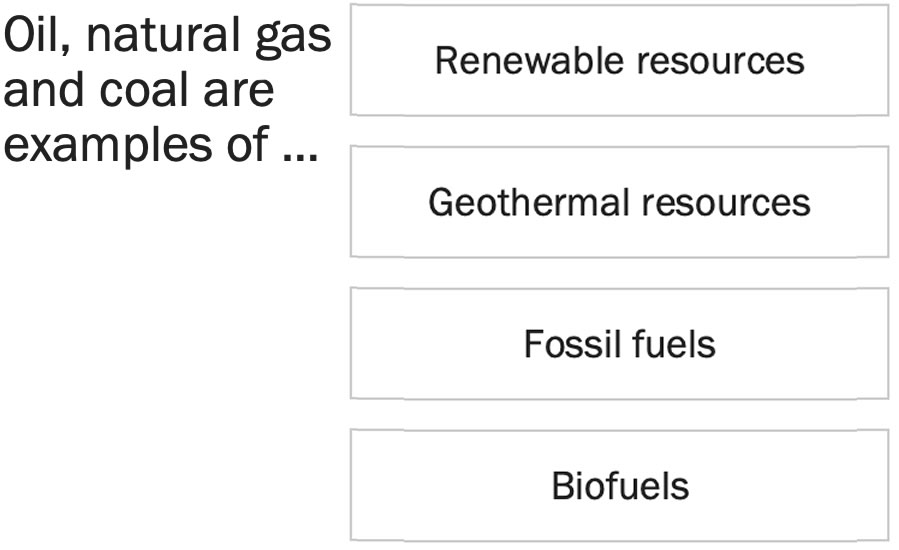
Take for example the question on antibiotic resistance (→).  The correct answer “it can lead to antibiotic-resistant bacteria” does not reveal whether the respondent understands the evolutionary (selective) basis for this effect, that is random mutagenesis (or horizontal gene transfer) and antibiotic-resistance based survival.  It is imaginable that a fundamentalist religious creationist could select the correct answer based on  plausible, non-evolutionary mechanisms (3).  In a different light, the question on oil, natural gas and coal (↓) could be seen as ambiguous – aren’t these all derived from long dead organisms, so couldn’t they reasonably be termed biofuels?  

While there are issues with almost any such multiple choice survey instrument, surely we would agree that choosing the “correct” answers to these 11 questions reflects some awareness of current scientific ideas and terminologies.  Certainly knowing (I think) that a base can neutralize and acid leaves unresolved how exactly the two interact, that is what chemical reaction is going on, not to mention what is going on in the stomach and upper gastrointestinal tract of a human being.  In this case, selecting the correct answer is not likely to conflict with one’s view of anthropogenic effects on climate, sex versus gender, or whether one has an up to date understanding of the mechanisms of immunity and brain development, or the social dynamics behind vaccination – specifically the responsibilities that members of a social group have to one another.   

But perhaps a more relevant point is our understanding of how science deals with the subject of predictions, because at the end of the day it is these predictions that may directly impact people in personal, political, and economically impactful ways. 

We can, I think, usefully divide scientific predictions into two general classes.  There are predictions about a system that can be immediately confirmed or dismissed through direct experiment and observation and those that cannot. The immediate (accessible) type of prediction is the standard model of scientific hypothesis testing, an approach that reveals errors or omissions in one’s understanding of a system or process.  Generally these are the empirical drivers of theoretical understanding (although perhaps not in some areas of physics).  The second type of prediction is inherently more problematic, as it deals with the currently unobservable future (or the distant past).  We use our current understanding of the system, and various assumptions, to build a predictive model of the system’s future behavior (or past events), and then wait to see if they are confirmed. In the case of models about the past, we often have to wait for a fortuitous discovery, for example the discovery of a fossil that might support or disprove our model.   

It’s tough to make predictions, especially about the future
– Yogi Berra (apparently)

Anthropogenic effects on climate are an example of the second type of prediction. No matter our level of confidence, we cannot be completely sure our model is accurate until the future arrives. Nevertheless, there is a marked human tendency to take predictions, typically about the end of the world or the future of the stock market, very seriously and to make urgent decisions based upon them. In many cases, these predictions impact only ourselves, they are personal.  In the case of climate change, however, they are likely to have disruptive effects that impact many. Part of the concern about study predictions is that responses to these predictions will have immediate impacts, they produce social and economic winners and losers whether or not the predictions are confirmed by events. As Hans Rosling points out in his book Factfullness, there is an urge to take urgent, drastic, and pro-active actions in the face of perceived (predicted) threats.  These recurrent and urgent calls to action (not unlike repeated, and unfulfilled predictions of the apocalypse) can lead to fatigue with the eventual dismissal of important warnings; warnings that should influence albeit perhaps not dictate ecological-economic and political policy decisions.  

Footnotes and literature cited:
1. As a Pew Biomedical Scholar, I feel some peripheral responsibility for the impact of these reports

2. As pointed out in a forthcoming review, the quality of the distractors, that is the incorrect choices, can dramatically impact the conclusions derived from such instruments. 

3.  I won’t say intelligent design creationist, as that makes no sense. Organisms are clearly not intelligently designed, as anyone familiar with their workings can attest

Drummond, C. & B. Fischhoff (2017). “Individuals with greater science literacy and education have more polarized beliefs on controversial science topics.” Proceedings of the National Academy of Sciences 114: 9587-9592.


Latest & past (PLoS Sci-Ed)

Most recent post:  Avoiding unrecognized racist implications arising from teaching genetics

Recent posts:

curlique

Please note, given the move from PLoS some of the links in the posts may be broken; some minor editing in process.  All by Mike Klymkowsky unless otherwise noted

Gradients & Molecular Switches: a biofundamentalist perspective

Embryogenesis is based on a framework of social (cell-cell) interactions, initial and early asymmetries, and cascading cell-cell signaling and gene regulatory networks (DEVO posts one, two, & three). The result is the generation of embryonic axes, germ layers (ectoderm, mesoderm, endoderm), various organs and tissues (brains, limbs, kidneys, hearts, and such) and their characteristic cell types, their patterning, and their coordination into a functioning organism. It is well established that all animals share a common ancestor (hundreds of millions of years ago) and that a number of molecular  modules were already present in that common ancestor.  

At the same time evolutionary processes are, and need to be, flexible enough to generate the great diversity of organisms, with their various adaptations to particular life-styles. The extent of both conservation and flexibility (new genes, new mechanisms) in developmental systems is, however, surprising. Perhaps the most striking evidence for the depth of this conservation was supplied by the discovery of the organization of the Hox gene cluster in the fruit fly Drosophila and in the mouse (and other vertebrates). In both, the Hox genes are arranged and expressed in a common genomic and expression patterns. But as noted by Denis Duboule (2007) Hox gene organization is often presented in textbooks in a distorted manner (↓).

hox gene cluster variation

The Hox gene clusters of vertebrates are compact, but are split, disorganized, and even “atomized” in other types of organisms. Similarly, processes that might appear foundational, such as the role of the Bicoid gradient in the early fruit fly embryo (a standard topic in developmental biology textbooks), is in fact restricted to a small subset of flies (Stauber et al., 1999). New genes can be generated through well defined processes, such as gene duplication and divergence, or they can arise de novo out of sequence noise (Carvunis et al., 2012; Zhao et al., 2014 – see Van Oss & Carvunis 2019. De novo gene birth). Comparative genomic analyses can reveal the origins of specific adaptations (see Stauber et al., 1999).  The result is that organisms as closely related to each other as the great apes (including humans) have significant species-specific genetic differences (see Florio et al., 2018; McLean et al., 2011; Sassa, 2013 and references therein) as well as common molecular and cellular mechanisms.

A universal (?) feature of developing systems – gradients and non-linear responses: There is a predilection to find (and even more to teach) simple mechanisms that attempt to explain everything (witness the distortion of the Hox cluster, above) – a form of physics “theory of everything” envy.  But the historic nature, evolutionary plasticity, and need for regulatory robustness generally lead to complex and idiosyncratic responses in biological systems.  Biological systems are not “intelligently designed” but rather cobbled together over time through noise (mutation) and selection (Jacob, 1977)(see blog post). 
That said, a  common (universal?) developmental process appears to be the transformation of asymmetries into unambiguous cell fate decisions. Such responses are based on threshold events controlled by a range of molecular behaviors, leading to discrete gene expression states. We can approach the question of how such decisions are made from both an abstract and a concrete perspective. Here I outline my initial approach – I plan to introduce organism specific details as needed.  I start with the response to a signaling gradient, such as that found in many developmental systems, including the vertebrate spinal cord (top image Briscoe and Small, 2015) and the early Drosophila embryo (Lipshitz, 2009)(↓). gradients-decisions

bicoid gradient - lipschitz

We begin with a gradient in the concentration of a “regulatory molecule” (the regulator).  The shape of the gradient depends upon the sites and rates of synthesis, transport away from these sites, and turnover (degradation and/or inactivation). We assume, for simplicity’s sake, that the regulator directly controls the expression of target gene(s). Such a molecule binds in a sequence specific manner to regulatory sites, there could be a few or hundreds, and lead to the activation (or inhibition) of the DNA-dependent, RNA polymerase (polymerase), which generates RNA molecules complementary to one strand of the DNA. Both the binding of the regulator and the polymerase are stochastic processes, driven by diffusion, molecular collisions, and binding interactions.(1) 

Let us now consider the response of target gene(s) as a function of cell position within the gradient.  We might (naively) expect that the rate of target gene expression would be a simple function of regulator concentration. For an activator, where the gradient is high, target gene expression would be high, where the gradient concentration is low, target gene expression would be low – in between, target gene expression would be proportional to regulator concentration.  But generally we find something different, we find that the expression of target genes is non-uniform, that is there are thresholds in the gradient: on one side of the threshold concentration the target gene is completely off (not expressed), while on the other side of the threshold concentration, the target gene is fully on (maximally expressed).  The target gene responds as if it is controlled by an on-off switch. How do we understand the molecular basis for this behavior? 

Distinct mechanisms are used in different systems, but we will consider a system from the gastrointestinal bacteria E. coli that students may already be familiar with; these are the genes that enable E. coli to digest the mammalian milk sugar lactose.  They encode a protein needed to import  lactose into a bacterial cell and an enzyme needed to break lactose down so that it can be metabolized.  Given the energetic cost to synthesize these proteins, it is in the bacterium’s adaptive self interest to synthesize them only when lactose is present at sufficient concentrations in their environment.  The response is functionally similar to that associated with quorum sensing, which is also governed by threshold effects. Similarly cells respond to the concentration of regulator molecules (in a gradient) by turning on specific genes in specific domains, rather than uniformly. 

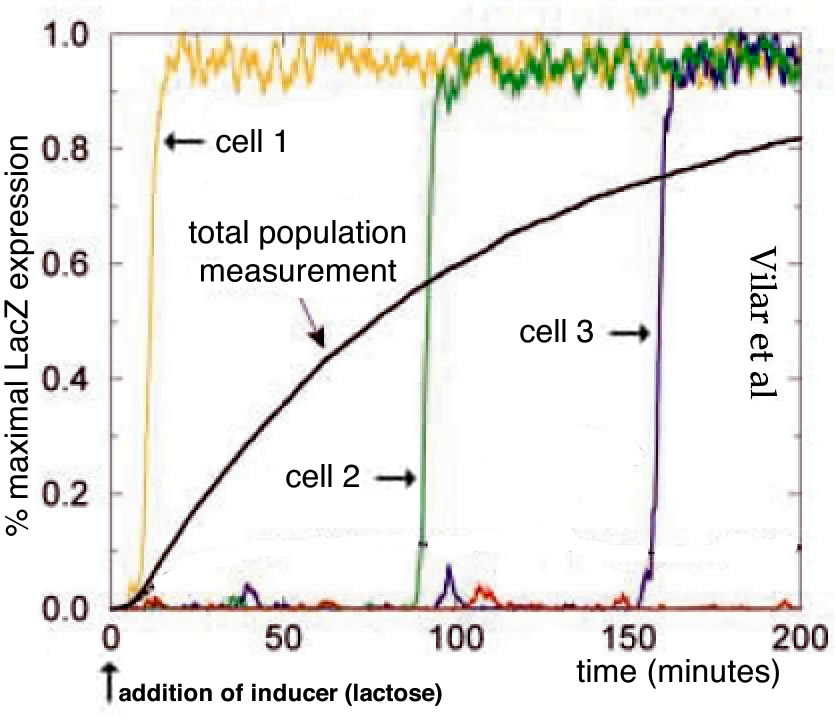
Now let us look in a little more detail at the behavior of the lactose utilization system in E. coli following an analysis by Vilar et al (2003)(2).  At an extracellular lactose concentration below the threshold, the system is off.  If we increase the extracellular lactose concentration above threshold the system turns on, the lactose permease and β-galactosidase proteins are made and lactose can enter the cell and be broken down to produce metabolizable sugars.  By looking at individual cells, we find that they transition, apparently stochastically from off to on (→), but whether they stay on depends upon the extracellular lactose concentration. We can define a concentration, the maintenance concentration, below the threshold, at which “on” cells will remain on, while “off” cells will remain off.  

The circuitry of the lactose system is well defined  (Jacob and Monod, 1961; Lewis, 2013; Monod et al., 1963)(↓).  The lacI gene encodes the lactose operon repressor protein and it is expressed constituately at a low level; it binds to sequences in the lac operon and inhibits transcription.  The lac operon itself contains three genes whose expression is regulated by a constituatively active promoter.  LacY encodes the permease while the lacZ encodes β-galactosidase.  β-galactosidase has two functions: it catalyzes the reaction that transforms lactose into allolactone and it cleaves lactose into the metabolically useful sugars glucose and galactose. Allolactone is an allosteric modulator of the Lac repressor protein; if allolactone is present, it binds to lac epressor proteins and inactivates them, allowing lac operon expression.  

The cell normally contains only ~10 lactose repressor proteins. Periodically (stochastically), even in the absence of lactose, and so its derivative allolactone, the lac operon promoter region is free of repressor proteins, and a lactose operon is briefly expressed – a few LacY and LacZ  polypeptides are synthesized (↓).  This noisy leakiness in the regulation of the lac operon allows the cell to respond if lactose happens to be present – some lactose molecules enter the cell through the permease, are converted to allolactone by β-galactosidase.  Allolactone is an allosteric effector of the lac repressor; when present it binds to and inactivates the lac repressor protein so that it no longer binds to its target sequences (the operator or “O” sites).  In the absence of repressor binding, the lac operon is expressed.  If lactose is not present, the lac operon is inhibited and lacY and LacZ disappear from the cell by turnover or growth associated dilution.     

The question of how the threshold concentration for various signal-regulated decisions is set often involves homeostatic processes that oppose the signaling response. The binding and activation of regulators can involve cooperative interactions between molecular components and both positive and negative feedback effects. 

In the case of patterning a tissue, in terms of regional responses to a signaling gradient, there can be multiple regulatory thresholds for different genes, as well as indirect effects, where the initiation of gene expression of one set of target genes impacts the sensitive expression of subsequent sets of genes.  One widely noted mechanism, known as reaction-diffusion, was suggested by the English mathematician Alan Turing (see Kondo and Miura, 2010) – it postulates a two component system. One component is an activator of gene expression, which in addition to its own various targets, positively regulates its own expression. The second component is a repressor of the first.  Both of these two regulator molecules are released by the signaling cell or cells; the repressor diffuses away from the source faster than the activator does.  The result can be a domain of target gene expression (where the concentration of activator is sufficient to escape repression), surrounded by a zone in which expression is inhibited (where repressor concentration is sufficient to inhibit the activator).  Depending upon the geometry of the system, this can result in discrete regions (dots or stripes) of primary target gene expression  (see Sheth et al., 2012).  In real systems there are often multiple gradients present; their relative orientations can produce a range of patterns.   

The point of all of this, is that when we approach a particular system – we need to consider the mechanisms involved.  Typically they are selected to produce desired phenotypes, but also to be robust in the sense that they need to produce the same patterns even if the system in which they occur is subject to perturbations, such as embryo/tissue size (due to differences in cell division / growth rates) and temperature and other environmental variables. 

note: figures returned – updated 13 November 2020.  

Footnotes:

  1. While stochastic (random) these processes can still be predictable.  A classic example involves the decay of an unstable isotope (atom), which is predictable at the population level, but unpredictable at the level of an individual atom.  Similarly, in biological systems, the binding and unbinding of molecules to one another, such as a protein transcription regulator to its target DNA sequence is stochastic but can be predictable in a large enough population.   
  2. and presented in biofundamentals ( pages 216-218). 

literature cited: 

Briscoe & Small (2015). Morphogen rules: design principles of gradient-mediated embryo patterning. Development 142, 3996-4009.

Carvunis et al  (2012). Proto-genes and de novo gene birth. Nature 487, 370.

Duboule (2007). The rise and fall of Hox gene clusters. Development 134, 2549-2560.

Florio et al (2018). Evolution and cell-type specificity of human-specific genes preferentially expressed in progenitors of fetal neocortex. eLife 7.

Jacob  (1977). Evolution and tinkering. Science 196, 1161-1166.

Jacob & Monod (1961). Genetic regulatory mechanisms in the synthesis of proteins. Journal of Molecular Biology 3, 318-356.

Kondo & Miura (2010). Reaction-diffusion model as a framework for understanding biological pattern formation. Science 329, 1616-1620.

Lewis (2013). Allostery and the lac Operon. Journal of Molecular Biology 425, 2309-2316.

Lipshitz (2009). Follow the mRNA: a new model for Bicoid gradient formation. Nature Reviews Molecular Cell Biology 10, 509.

McLean et al  (2011). Human-specific loss of regulatory DNA and the evolution of human-specific traits. Nature 471, 216-219.

Monod Changeux & Jacob (1963). Allosteric proteins and cellular control systems. Journal of Molecular Biology 6, 306-329.

Sassa (2013). The role of human-specific gene duplications during brain development and evolution. Journal of Neurogenetics 27, 86-96.

Sheth et al (2012). Hox genes regulate digit patterning by controlling the wavelength of a Turing-type mechanism. Science 338, 1476-1480.

Stauber et al (1999). The anterior determinant bicoid of Drosophila is a derived Hox class 3 gene. Proceedings of the National Academy of Sciences 96, 3786-3789.

Vilar et al (2003). Modeling network dynamics: the lac operon, a case study. J Cell Biol 161, 471-476.

Zhao et al (2014). Origin and Spread of de Novo Genes in Drosophila melanogaster Populations. Science. 343, 769-772