
In the context of public discourse, there are times when one is driven to simple, reflexive and often disproportionate (exasperated) responses. That happens to me whenever people talk about the various theories that they apply to a process or event. I respond by saying (increasingly silently to myself), that what they mean is really that they have an idea, a model, a guess, a speculation, or a comforting “just-so” story. All too often such competing “theories” are flexible enough to explain (or explain away) anything, depending upon one’s predilections. So why a post on theories? Certainly the point as been made before (see Ghose. 2013. “Just a Theory”: 7 Misused Scie nce Words“). Basically because the misuse of the term theory, whether by non-scientists, scientists, or science popularizers, undermines understanding of, and respect for the products of the scientific enterprise. It confuses hard won knowledge with what are often superficial (or self-serving) opinions. When professors, politicians, pundits, PR flacks, or regular people use the word theory, they are all too often, whether consciously or not, seeking to elevate their ideas through the authority of science.
So what is the big deal anyway, why be an annoying pain in the ass (see Christopher DiCarlo’s video), challenging people, making them uncomfortable, and making a big deal about something so trivial. But is it really trivial? I think not, although it may well be futile or quixotic. The inappropriate use of the word theory, particularly by academics, is an implicit attempt to gain credibility. It is also an attack on the integrity of science. Why? Because like it or not, science is the most powerful method we have to understand how the world works, as opposed to what the world or our existence within the world means. The scientific enterprise, abiding as it does by explicit rules of integrity, objective evidence, logical and quantifiable implications, and their testing has been a progressive social activity, leading to useful knowledge – knowledge that has eradicated small pox and polio (almost) and produced iPhones, genetically modified organisms, and nuclear weapons. That is not to say that the authority of science has not been repeatedly been used to justify horrific sociopolitical ideas, but those ideas have not been based on critically evaluated and tested scientific theories, but on variously baked ideas that claim the support of science (both the eugenics and anti-vaccination movements are examples).
 Modern science is based on theories, ideas about the universe that explain and predict what we will find when we look (smell, hear, touch) carefully at the world around us. And these theories are rigorously and continually tested, quantitatively – in fact one might say that the ability to translate a theory into a quantitative prediction is one critical hallmark of a real versus an ersatz (non-scientific) theory [here is a really clever approach to teaching students about facts and theories, from David Westmoreland]
So where do (scientific) theories come from? Initially they are guesses about how the world works, as stated by Richard Feynman and the non-scientific nature of vague “theories”. Guesses that have evolved based on testing, confirmation, and where wrong – replacement with more and more accurate, logically well constructed and more widely applicable constructs – an example of the evolution of scientific knowledge. That is why ideas are cheap, they never had, or do not develop the disciplinary rigor necessary to become a theory. In fact, it often does not even matter, not really, to the people propounding these ideas whether they correspond to reality at all, as witness the stream of tweets from various politicians or the ease with which many apocalyptic predictions are replaced when they turn out to be incorrect. But how is the average person to identify the difference between a (more or less half-baked) idea and a scientific theory? Probably the easiest way is to ask, is the idea constantly being challenged, validated, and where necessary refined by both its proponents and its detractors. One of the most impressive aspects of Einstein’s theory of general relativity is the accuracy of its predictions (the orbit of Mercury, time-dilation, and gravitational waves (link)), predictions that if not confirmed would have forced its abandonment – or at the very least serious revision. It is this constant application of a theory, and the rigorous testing of its predictions (if this, then that) that proves its worth.
Another aspect of a scientific theory is whether it is fecund or sterile. Does its application lead to new observations that it can explain? In contrast, most ideas are dead ends. Consider the recent paper on the possibility that life arose outside of the Earth, a proposal known as pan-spermia (1) – “a very plausible conclusion – life may have been seeded here on Earth by life-bearing comets” – and recently tunneling into the web’s consciousness in stories implying the extra-terrestrial origins of cephalopods (see “no, octopuses don’t come from outer space.”) Unfortunately, no actual biological insights emerge from this idea (wild speculation), since it simply displaces the problem, if life did not arise here, how did it arise elsewhere? If such ideas are embraced, as is the case with many religious ideas, their alteration often leads to violent schism rather than peaceful refinement. Consider, as an example, an idea had by an archaic Greek or two that the world was made of atoms. These speculations were not theories, since their implications were not rigorously tested. The modern atomic theory has been evolving since its introduction by Dalton, and displays the diagnostic traits of a scientific theory. Once introduced to explain the physical properties of matter, it led to new discoveries and explanations for the composition and structure of atoms themselves (electrons, neutrons, and protons), and then to the composition and properties of these objects, quarks and such (link to a great example.)
Scientific theories are, by necessity, tentative (again, as noted by Feynman) – they are constrained and propelled by new and more accurate observations. A new observation can break a theory, leading it to be fixed or discarded. When that happens, the new theory explains (predicts) all that the old theory did and more. This is where discipline comes in; theories must meet strict standards – the result is that generally there cannot be two equivalent theories that explain the same phenomena – one (or both) must be wrong in some important ways. There is no alternative, non-atomic theory that explains the properties of matter.
The assumption is that two “competing” theories will make distinctly different predictions, if we look (and measure) carefully enough. There are rare cases where two “theories” make the same predictions; the classic example is the Ptolemaic Sun-centered and the Copernican Earth-centered models of the solar system. Both explained the appearances of planetary motion more or less equally well, and so on that basis there was really no objective reason to choose between them. In part, this situation arose from an unnecessary assumption underlying both models, namely that celestial objects moved in perfect circular orbits – this assumption necessitated the presence of multiple “epicycles” in both models. The real advance came with Kepler’s recognition that celestial objects need not travel in perfect circular orbits, but rather in elliptical orbits; this liberated models of the solar system from the need for epicycles. The result was the replacement of “theories of solar system movement” with a theory of planetary/solar/galactic motions”.
Whether, at the end of the day scientific theories are comforting or upsetting, beautiful or ugly remains to be seen, but what is critical is that we defend the integrity of science and call out the non-scientific use of the word theory, or blame ourselve for the further decay of civilization (perhaps I am being somewhat hyperbolic – sorry).
 notes:
1. Although really, pan-oogenia would be better. Sperm can do nothing without an egg, but an unfertilized egg can develop into an organism, as occurs with bees.

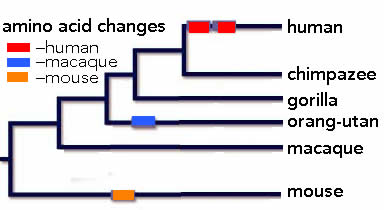 these two amio acid changes alter the activity of the human protein, that is the ensemble of genes that it regulates. That foxp2 has an important role in humans was revealed through studies of individuals in a family that displayed a severe language disorder linked to a mutation that disrupts the function of the foxp2 protein. Individuals carrying this mutant foxp2 allele display speech apraxia, a “severe impairment in the selection and sequencing of fine oral and facial movements, the ability to break up words into their constituent phonemes, and the production and comprehension of word inflections and syntax” (cited in
  Glial cells are the major non-neuronal component of the central nervous system. Once thought of as passive “support” cells, it is now clear that the two major types of glia, known as astrocytes and oligodendrocytes, play a number of important roles in neural functioning [
 Subsequently, Goldman and associates used a variant of this approach to introduce hGPCs (derived from human embryonic stem cells) carrying either a normal or mutant version of the Huntingtin protein, a protein associated with the severe neural disease Huntington’s chorea (OMIM:
  The second obstacle to pig → human transplantation is the presence of retroviruses within the pig genome. All vertebrate genomes, including those of humans, contain many inserted retroviruses; almost 50% of the human genome is retrovirus-derived sequence (an example of unintelligent design if ever there was one). Most of these endogenous retroviruses are “under control” and are normally benign (see
 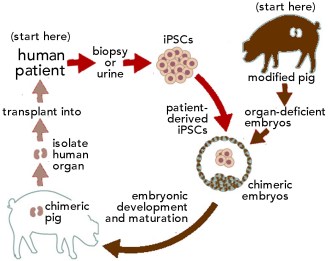 or eyes can be generated. In an embryo that cannot make these organs, which can be a lethal defect, the introduction of stem cells from an animal that can form these organs can lead to the formation of an organ composed primarily of cells derived from the transplanted (human) cells.
 hat the presentation of science in a sociopolitical contexts can emphasize learning of more than just science. Current approaches to education tend to compartmentalize academic subjects, framing them as standalone lessons and philosophies. Students go through the school day motions, attending English class, then biology, then social studies, then trigonometry, etc., and the natural connections among subject areas are often lost. When framing scientific topics in the context of sociopolitical discussions and debates, stu
 Ph.D. in metabolic biology from Columbia University, followed by a postdoc in the Laboratory of Biochemical Genetics and Metabolism at The Rockefeller University, where she now serves as Director of Science Outreach. In this role, she works to provide K-12 communities with equitable access to authentic biomedical research opportunities and resources. You can find Jeanne on social media under the handle @JeanneGarb.
 bioliteracy / biofundamentals