W. F. R. Weldon’s Critique of Mendel’s Work: Biological Relevance and Context. 

A RAG-ChatGPT written backgrounder (checked and edited by Mike Klymkowsky ) for the excessively curious – in support of biofundamentals – 1 August 2025

Weldon’s Background and Perspective: Walter F. R. Weldon (1860–1906) was a British zoologist and a pioneer of biometry – the statistical study of biological variation. He believed that evolution operated through numerous small, continuous variations rather than abrupt, either-or traits. In his studies of creatures like shrimps and crabs, Weldon found that even traits which appeared dimorphic at first could grade into one another when large enough samples were measured [link]. He and his colleague Karl Pearson (1857-1936) argued that Darwin’s theory of natural selection was best tested with quantitative methods: “the questions raised by the Darwinian hypothesis are purely statistical, and the statistical method is the only one at present obvious by which that hypothesis can be experimentally checked” [link]. This emphasis on gradual variation and statistical analysis set Weldon at odds with the emerging Mendelian school of genetics, led by William Bateson (1861-1926) that focused on discrete traits and sudden changes. By 1902, the scientific community had split into two camps – the biometricians (Weldon and Pearson in London) versus the Mendelians (Bateson and allies in Cambridge) – reflecting deep disagreements over the nature of heredity [link]. This was the charged backdrop against which Weldon evaluated Gregor Mendel’s pea-breeding experiments.

Critique of Mendel’s Pea Traits and Categories Weldon’s photographic plate of peas illustrating continuous variation in seed color. (This figure from his 1902 paper shows pea seeds ranging from green to yellow in a smooth gradient, contradicting the clear-cut “green vs. yellow” categories assumed by Mendel [link]. Images 1–6 and 7–12 (top rows) display the range of cotyledon colors in two different pea varieties after the seed coats were removed [link]. Instead of all seeds being simply green or yellow, Weldon documented many intermediate shades. He even found seeds whose two cotyledons (halves) differed in color, underscoring that Mendel’s binary categories were oversimplifications of a more complex reality [link].

Weldon closely re-examined the seven pea traits Mendel had chosen (such as seed color and seed shape) and argued that Mendel’s tidy classifications did not reflect biological reality in peas. In Mendel’s account, peas were either “green” or “yellow” and produced either “round, smooth” or “wrinkled” seeds, with nothing in between. Weldon showed this was an artifact of Mendel’s experimental design. He gathered peas from diverse sources and found continuous variation rather than strict binary types. For example, a supposedly pure “round-seeded” variety produced seeds with varying degrees of roundness and wrinkling [link]. Likewise, seeds that would be classified as “green” or “yellow” in Mendel’s scheme actually exhibited a spectrum of color tones from deep green through greenish-yellow to bright yellow [link]. Weldon’s observations were impossible to reconcile with a simple either/or trait definition [link].

Weldon concluded that Mendel had deliberately picked atypical pea strains with stark, discontinuous traits, and that Mendel’s category labels (e.g. “green vs. yellow” seeds) obscured the true, much more variable nature of those characters [link]. In Weldon’s view, the neat ratios Mendel obtained were only achievable because Mendel worked with artificially generated lines of peas, bred to eliminate intermediate forms [link]. In ordinary pea populations that a farmer or naturalist might encounter, such clear-cut divisions virtually disappeared: “Many races of peas are exceedingly variable, both in colour and in shape,” Weldon noted, “so that both the category ‘round and smooth’ and the category ‘wrinkled and irregular’ include a considerable range of varieties.” [link] In short, he felt Mendel’s chosen traits were too simple and unrepresentative. The crisp binary traits in Mendel’s experiments were the exception, not the rule, in nature. Weldon’s extensive survey of pea varieties led him to believe that Mendel’s results “had no validity beyond the artificially “purified”in-bred” races Mendel worked with,” because the binary categories “obscured a far more variable reality.”[link]

Mendel’s Conclusions and Real-World Heredity. Weldon went beyond critiquing Mendel’s choice of traits – he questioned whether Mendel’s conclusions about heredity were biologically meaningful for understanding inheritance in real populations. Based on his empirical findings and evolutionary perspective, Weldon doubted that Mendel’s laws could serve as general laws of heredity. Some of his major biological objections were:

Traits are seldom purely binary in nature: Outside the monk’s garden, most characteristics do not sort into a few discrete classes. Instead, they form continuous gradations. Weldon realized that Mendel’s insistence on traits segregating neatly into “either/or” categories “simply wasn’t true,” even for peas [link]. Mendel’s clear ratios were achieved by excluding the normal range of variation; in the wild, peas varied continuously from yellow to green with every shade in between [link]. What Mendel presented as unitary “characters” were, in Weldon’s eyes, extremes picked from a continuum.

Mendel’s results were an artifact of pure-breeding: Weldon argued that the famous 3:1 ratios and other patterns were only apparent because Mendel had used highly inbred, “pure” varieties. By extensive inbreeding and selection, Mendel stripped away intermediate variants [link]. The artificially uniform parent strains used in Mendel’s experiments do not reflect natural populations. Weldon concluded that the seeming universality of Mendel’s laws was misleading – they described those special pea strains, not peas (or other organisms) at large [link]. In a letter, he even mused whether Mendel’s remarkably clean data were “too good” to be true, hinting that real-world data would rarely align so perfectly [link].

Dominance is not an absolute property: A cornerstone of Mendelism was that one trait form is dominant over the other (e.g. yellow dominates green). Weldon questioned this simplistic view. He gathered evidence that whether a given trait appears dominant or recessive can depend on context – on the plant’s overall genetic background and environmental conditions [link]. For example, a seed color might behave as dominant in one cross but not in another, if other genetic factors differ. Weldon argued that Mendel’s concept of dominance was “oversimplified” because it treated dominance as inherent to a trait, independent of development or ancestry [link]. In reality (as Weldon emphasized), “the effect of the same bit of chromosome can be different depending on the hereditary background and the wider environmental conditions”, so an inherited character’s expression isn’t fixed as purely dominant or recessive [link]. This questioned the biological generality of Mendel’s one-size-fits-all dominance rule.

Atavism and ancestral influence: Perhaps most intriguing was Weldon’s concern with reversion (atavism) – cases where an offspring exhibits a trait of a distant ancestor that had seemingly disappeared in intervening generations. Breeders of plants and animals had long reported that occasionally a “throwback” individual would appear, showing an old parental form or color after many generations of absence. To Weldon, such phenomena implied that heredity isn’t solely about the immediate parents’ genes, but can be influenced by more remote ancestral contributions [link]. “Mendel treats such characters as if the condition in two given parents determined the condition in all their offspring,” Weldon wrote, but breeders know that “the condition of an organism does not as a rule depend upon [any one pair of ancestors] alone, but in varying degrees upon the condition of all its ancestors in every past generation” [link]. In other words, the influence of a trait could accumulate or skip generations. This idea directly conflicted with Mendel’s theory as presented in 1900, which only considered inheritance from the two parents and had no mechanism for latent ancestral traits resurfacing after several generations. Weldon concluded from examples of reversion that Mendel’s framework was biologically incomplete – there had to be “more going on” in heredity than Mendel’s laws acknowledged [link].

In sum, Weldon found Mendel’s laws too limited and idealized to account for the messy realities of inheritance in natural populations. Mendel had demonstrated elegant numerical ratios with a few pea characters, but Weldon did not believe those results scaled up to the complex heredity of most traits or species. Variation, continuity, and context were central in Weldon’s view of biology, whereas Mendel’s work (as interpreted by Mendel’s supporters) seemed to ignore those factors. Thus, Weldon saw Mendel’s conclusions as at best a special case – interesting, but not the whole story of heredity in the real world [link][link].

Weldon’s Legacy

Weldon’s critiques came at a time of intense debate between the “Mendelians” and the “Biometricians.” William Bateson, the chief Mendelian, vehemently defended Mendel’s theory against Weldon’s attacks. In 1902, Bateson published a lengthy rebuttal titled Mendel’s Principles of Heredity: A Defense, including a 100-page polemic aimed squarely at “defending Mendel from Professor Weldon”[link]. Bateson and his allies believed Weldon had misinterpreted Mendel and that discrete Mendelian factors really were the key to heredity. The clash between Weldon and Bateson grew increasingly personal and public. By 1904 the feud had become so heated that the editor of Nature refused to publish any further exchanges between the two sides [link]. At a 1904 British Association meeting, a debate between Bateson and Weldon on evolution and heredity became a shouting match, emblematic of how divisive the issue had become [link][link].

Although Weldon’s objections were rooted in biological observations, many contemporaries saw the dispute as one of old guard vs. new ideas. Tragically, Weldon died in 1906 at the age of 46, with a major manuscript on inheritance still unfinished [link]. In that unpublished work, he had gathered experimental data to support a more nuanced theory reconciling heredity with development and ancestral effects [link][link]. With his early  death, much of Weldon’s larger critique faded from the spotlight. Mendelian genetics, championed by Bateson and later enriched by the chromosome theory, surged ahead. Nevertheless, in hindsight many of Weldon’s points were remarkably prescient. His insistence on looking at population-level variation and the importance of multiple factors and environment foreshadowed the modern understanding that Mendelian genes can interact in complex ways (for example, polygenic inheritance and gene-by-environment effects). As one historian noted, Weldon’s critiques of Mendelian principles were “100 years ahead of his time” [link]. In the context of his era, Weldon doubted the biological relevance of Mendel’s peas for the broader canvas of life – and while Mendel’s laws did prove fundamental, Weldon was correct that real-world heredity is more intricate than simple pea traits. His challenge to Mendelism ultimately pushed geneticists to grapple with continuous variation and population dynamics, helping lay the groundwork for the synthesis of Mendelian genetics with biometry in the decades after his death[link][link].

Sources: Weldon’s 1902 paper in Biometrika and historical analyses [link][link][link][link][link][link][link]provide the basis for the above summary. These document Weldon’s arguments that Mendel’s pea traits were overly simplistic and his laws of heredity not universally applicable to natural populations, especially in light of continuous variation, context-dependent trait expression, and atavistic reversions. The debate between Weldon and the Mendelians is detailed in contemporary accounts and later historical reviews [link][link], illustrating the scientific and conceptual rift that formed around Mendel’s rediscovered work.

Sounds like science, but it ain’t …

we are increasingly assailed with science-related “news” – stories that too often involve hype and attempts to garner attention (and no, half-baked ideas are not theories, they are often non-scientific speculation or unconstrained fantasies).

The other day, as is my addiction, I turned to the “Real Clear Science” website to look for novel science-based stories (distractions from the more horrifying news of the day). I discovered two links that seduced me into clicking: “Atheism is not as rare or as rational as you think” by Will Gervais and Peter Sjöstedt-H’s “Consciousness and higher spatial dimensions“.  A few days later I encountered “Consciousness Is the Collapse of the Wave Function” by Stuart Hameroff. On reading them (more below), I faced the realization that science itself, and its distorted popularization by both institutional PR departments and increasingly by scientists and science writers, may be partially responsible for the absurdification of public discourse on scientific topics [1].  In part the problem arises from the assumption that science is capable of “explaining” much more than is actually the case. This insight is neither new nor novel. Timothy Caulfield’s essay Pseudoscience and COVID-19 — we’ve had enough already focuses on the fact that various, presumably objective data-based, medical institutions have encouraged the public’s thirst for easy cures for serious, and often incurable diseases.  As an example, “If a respected institution, such as the Cleveland Clinic in Ohio, offers reiki — a science-free practice that involves using your hands, without even touching the patient, to balance the “vital life force energy that flows through all living things” — is it any surprise that some people will think that the technique could boost their immune systems and make them less susceptible to the virus?” That public figures and trusted institutions provide platforms for such silliness [see Did Columbia University cut ties with Dr. Oz?] means that there is little to distinguish data-based treatments from faith- and magical-thinking based placebos. The ideal of disinterested science, while tempered by common human frailties, is further eroded by the lure of profit and/or hope of enhanced public / professional status and notoriety.  As noted by Pennock‘ “Science never guarantees absolute truth, but it aims to seek better ways to assess empirical claims and to attain higher degrees of certainty and trust in scientific conclusions“. Most importantly, “Science is a set of rules that keep the scientists from lying to each other. [2]

It should surprise no one that the failure to explicitly recognize the limits, and evolving nature of scientific knowledge, opens the door to self-interested hucksterism at both individual and institutional levels. Just consider the number of complementary/alternative non-scientific “medical” programs run by prestigious institutions. The proliferation of pundits, speaking outside of their areas of established expertise, and often beyond what is scientifically knowable (e.g. historical events such as the origin of life or the challenges of living in the multiverse which are, by their very nature, unobservable) speaks to the increasingly unconstrained growth of pathological, bogus, and corrupted science  which, while certainly not new [3], has been facilitated by the proliferation of public, no-barrier, no-critical feedback platforms [1,4].  Ignoring the real limits of scientific knowledge and rejecting, or ignoring, the expertise of established authorities, rejects the ideals that have led to science that “works”.  

Of course, we cannot blame the distortion of science for every wacky idea; crazy, conspiratorial and magical thinking may well be linked to the cognitive “features” (or are they bugs) of the human brain. Norman Cohn describes the depressing, and repeated pattern behind the construction of dehumanizing libels used to justify murderous behaviors towards certain groups [5].  Recent studies indicate that brains, whether complex or simple neural networks, appear to construct emergent models of the world, models they use to coordinate internal perceptions with external realities [6].  My own (out of my area of expertise) guess is that the complexity of the human brain is associated with, and leads to the emergence of internal “working models” that attempt to make sense of what is happening to us, in part to answer questions such as why the good die young and the wicked go unpunished. It seems likely that our social nature (and our increasing social isolation) influences these models, models that are “checked” or “validated” against our experiences. 

It was in this context that Gervais’s essay on atheism caught my attention. He approaches two questions: “how Homo sapiens — and Homo sapiens alone — came to be a religious species” and “how disbelief in gods can exist within an otherwise religious species?”  But is Homo sapiens really a religious species and what exactly is a religion? Is it a tool that binds social groups of organisms together, a way of coping with, and giving meaning to, the (apparent) capriciousness of existence and experience, both, or something else again?  And how are we to know what is going on inside other brains, including the brains of chimps, whales, or cephalopods? In this light I was struck by an essay by Sofia Deleniv “The ‘me’ illusion: How your brain conjures up your sense of self” that considers the number of species that appear to be able to recognize themselves in a mirror. Turns out, this is not nearly as short a list as was previously thought, and it seems likely that self-consciousness, the ability to recognize yourself as you, may be a feature of many such systems.  Do other organisms possess emergent “belief systems” that help process incoming and internal signals, including their own neural noise? When the author says, “We then subtly gauge participants’ intuitions” by using “a clever experiment to see how people mentally represent atheists” one is left to wonder whether there are direct and objective measures of “intuitions” or “mental representations”?   Then the shocker, after publishing a paper claiming that “Analytic Thinking Promotes Religious Disbelief“, the authors state that “the experiments in our initial Science paper were fatally flawed, the results no more than false positives.’ One is left to wonder did the questions asked make sense in the first place. While it initially seemed scientific (after all it was accepted and published in a premiere scientific journal), was it ever really science? 

Both “Consciousness and Higher Spatial Dimensions” and “Consciousness Is the Collapse of the Wave Function”, sound very scientific. Some physicists (the most sciencey of scientists, right?) have been speculating via “string theory” and “multiverses”, a series of unverified (and likely unverifiable) speculations, that they universe we inhabit has many many more than the three spatial dimensions we experience.  But how consciousness, an emergent property of biological (cellular) networks, is related to speculative physics is not clear, no matter what Nobel laureates in physics may say.  Should we, the people, take these remarks seriously?  After all these are the same folks who question the reality of time (for no good reason, as far as I can tell, as I watch my new grandchild and myself grow older rather than younger). 

Part of the issue involves what has been called “the hard problem of consciousness”, but as far as I can tell, consciousness is not a hard problem, but a process that emerges from systems of neural cells, interacting with one another and their environment in complex ways, not unlike the underlying processes of embryonic development, in which a new macroscopic organism composed of thousands to billions of cells emerges from a single cell.  And if the brain and body are generating signals (thoughts) then in makes sense these in turn feed back into the system, and as consciousness becomes increasingly complex, these thoughts need to be “understood” by the system that produced them.  The system may be forced to make sense of itself (perhaps that is how religions and other explanatory beliefs come into being, settling the brain so that it can cope with the material world, whether a nematode worm, an internet pundit, a QAnon wack-o, a religious fanatic, or a simple citizen, trying to make sense of things.

Thanks to Melanie Cooper for editorial advice and Steve Pollock for checking my understanding of physics; all remaining errors are mine alone!

  1. Scheufele, D. A. and Krause, N. M. (2019). Science audiences, misinformation, and fake news. Proceedings of the National Academy of Sciences 116, 7662-7669
  2. Kenneth S. Norris, cited in False Prophet by Alexander Kohn (and cited by John Grant in Corrupted Science. 
  3.  See Langmuir, I. (1953, recovered and published in 1989). “Pathological science.” Research-Technology Management 32: 11-17; “Corrupted Science: Fraud, Ideology, and Politics in Science” and “Bogus Science: or, Some people really believe these things” by John Grant (2007 and 2009)
  4.  And while I personally think Sabine Hossenfelder makes great explanatory videos, even she is occasionally tempted to go beyond the scientifically demonstrable: e.g. You don’t have free will, but don’t worry and An update on the status of superdeterminism with some personal notes  
  5.  Norman Cohn’s (1975) “Europe’s Inner Demons” will reveal.
  6. Kaplan, H. S. and Zimmer, M. (2020). Brain-wide representations of ongoing behavior: a universal principle? Current opinion in neurobiology 64, 60-69.

Misinformation in and about science.

originally published as https://facultyopinions.com/article/739916951 – July 2021

There have been many calls for improved “scientific literacy”. Scientific literacy has been defined in a number of, often ambiguous, ways (see National Academies of Sciences and Medicine, 2016 {1}). According to Krajcik & Sutherland (2010) {2} it is “the understanding of science content and scientific practices and the ability to use that knowledge”, which implies “the ability to critique the quality of evidence or validity of conclusions about science in various media, including newspapers, magazines, television, and the Internet”. But what types of critiques are we talking about, and how often is this ability to critique, and the scientific knowledge it rests on, explicitly emphasized in the courses non-science (or science) students take? As an example, highlighted by Sabine Hossenfelder (2020) {3}, are students introduced to the higher order reasoning and understanding of the scientific enterprise needed to dismiss a belief in a flat (or a ~6000 year old) Earth?

While the sources of scientific illiteracy are often ascribed to social media, religious beliefs, or economically or politically motivated distortions, West and Bergstrom point out how scientists and the scientific establishment (public relations departments and the occasional science writer) also play a role. They identify the problems arising from the fact that the scientific enterprise (and the people who work within it) act within “an attention economy” and “compete for eyeballs just as journalists do.” The authors provide a review of all of the factors that contribute to misinformation within the scientific literature and its media ramifications, including the contribution of “predatory publishers” and call for “better ways of detecting untrustworthy publishers.” At the same time, there are ingrained features of the scientific enterprise that serve to distort the relevance of published studies, these include not explicitly identifying the organism in which the studies are carried out, and so obscuring the possibility that they might not be relevant to humans (see Kolata, 2013 {4}). There are also systemic biases within the research community. Consider the observation, characterized by Pandey et al. (2014) {5} that studies of “important” genes, expressed in the nervous system, are skewed: the “top 5% of genes absorb 70% of the relevant literature” while “approximately 20% of genes have essentially no neuroscience literature”. What appears to be the “major distinguishing characteristic between these sets of genes is date of discovery, early discovery being associated with greater research momentum—a genomic bandwagon effect”, a version of the “Matthew effect” described by Merton (1968) {6}. In the context of the scientific community, various forms of visibility (including pedigree and publicity) are in play in funding decisions and career advancement. Not pointed out explicitly by West and Bergstrom is the impact of disciplinary experts who pontificate outside of their areas of expertise and speculate beyond what can be observed or rejected experimentally, including speculations on the existence of non-observable multiverses, the ubiquity of consciousness (Tononi & Koch, 2015 {7}), and the rejection of experimental tests as a necessary criterion of scientific speculation (see Loeb, 2018 {8}) spring to mind.

Many educational institutions demand that non-science students take introductory courses in one or more sciences in the name of cultivating “scientific literacy”. This is a policy that seems to me to be tragically misguided, and perhaps based more on institutional economics than student learning outcomes. Instead, a course on “how science works and how it can be distorted” would be more likely to move students close to the ability to “critique the quality of evidence or validity of conclusions about science”. Such a course could well be based on an extended consideration of the West and Bergstrom article, together with their recently published trade book “Calling bullshit: the art of skepticism in a data-driven world” (Bergstrom and West, 2021 {9}), which outlines many of the ways that information can be distorted. Courses that take this approach to developing a skeptical (and realistic) approach to understanding how the sciences work are mentioned, although what measures of learning outcomes have been used to assess their efficacy are not described.

literature cited

  1. Science literacy: concepts, contexts, and consequencesCommittee on Science Literacy and Public Perception of Science, Board on Science Education, Division of Behavioral and Social Sciences and Education, National Academies of Sciences, Engineering, and Medicine.2016 10 14; PMID: 27854404
  2. Supporting students in developing literacy in science. Krajcik JS, Sutherland LM.Science. 2010 Apr 23; 328(5977):456-459PMID: 20413490
  3. Flat Earth “Science”: Wrong, but not Stupid. Hossenfelder S. BackRe(Action) blog, 2020, Aug 22 (accessed Jul 29, 2021)
  4. Mice fall short as test subjects for humans’ deadly ills. Kolata G. New York Times, 2013, Feb 11 (accessed Jul 29, 2021)
  5. Functionally enigmatic genes: a case study of the brain ignorome. Pandey AK, Lu L, Wang X, Homayouni R, Williams RW.PLoS ONE. 2014; 9(2):e88889PMID: 24523945
  6. The Matthew Effect in Science: The reward and communication systems of science are considered.Merton RK.Science. 1968 Jan 5; 159:56-63 PMID: 17737466
  7. Consciousness: here, there and everywhere? Tononi G, Koch C.Philos Trans R Soc Lond B Biol Sci. 2015 May 19; 370(1668)PMID: 25823865
  8. Theoretical Physics Is Pointless without Experimental Tests. Loeb A. Scientific American blog, 2018, Aug 10 [ Blog piece] (accessed Jul 29, 2021)
  9. Calling bullshit: the art of skepticism in a data-driven world.Bergstrom CT, West JD. Random House Trade Paperbacks, 2021ISBN: ‎ 978-0141987057

Science “awareness” versus “literacy” and why it matters, politically.

Montaigne concludes, like Socrates, that ignorance aware of itself is the only true knowledge”  – from “forbidden knowledge” by Roger Shattuck

A month or so ago we were treated to a flurry of media excitement surrounding the release of the latest Pew Research survey on Americans’ scientific knowledge.  The results of such surveys have been interpreted to mean many things. As an example, the title of Maggie Koerth-Baker’s short essay for the 538 web site was a surprising “Americans are Smart about Science”, a conclusion not universally accepted (see also).  Koerth-Baker was taken by the observation that the survey’s results support a conclusion that Americans’ display “pretty decent scientific literacy”.  Other studies (see Drummond & Fischhoff 2017) report that one’s ability to recognize scientifically established statements does not necessarily correlate with the acceptance of science policies – on average climate change “deniers” scored as well on the survey as “acceptors”.  In this light, it is worth noting that science-based policy pronouncements generally involve projections of what the future will bring, rather than what exactly is happening now.  Perhaps more surprisingly, greater “science literacy” correlates with more polarized beliefs that, given the tentative nature of scientific understanding –which is not about truth per se but practical knowledge–suggests that the surveys’ measure something other than scientific literacy.  While I have written on the subject before  it seems worth revisiting – particularly since since then I have read Rosling’s FactFullness and thought more about the apocalyptic bases of many secular and religious movements, described in detail by the historian Norman Cohn and the philosopher John Gray and gained a few, I hope, potentially useful insights on the matter.  

First, to understand what the survey reports we should take a look at the questions asked and decide what the ability to chose correctly implies about scientific literacy, as generally claimed, or something simpler – perhaps familiarity.  It is worth recognizing that all such instruments, particularly  those that are multiple choice in format, are proxies for a more detailed, time consuming, and costly Socratic interrogation designed to probe the depth of a persons’ knowledge and understanding.  In the Pew (and most other such surveys) choosing the correct response implies familiarity with various topics impacted by scientific observations. They do not necessarily reveal whether or not the respondent understands where the ideas come from, why they are the preferred response, or exactly where and when they are relevant (2). So is “getting the questions correct” demonstrates a familiarity with the language of science and some basic observations and principles but not the limits of respondents’ understanding.  

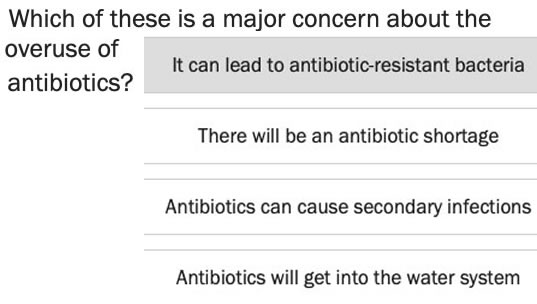
Take for example the question on antibiotic resistance (→).  The correct answer “it can lead to antibiotic-resistant bacteria” does not reveal whether the respondent understands the evolutionary (selective) basis for this effect, that is random mutagenesis (or horizontal gene transfer) and antibiotic-resistance based survival.  It is imaginable that a fundamentalist religious creationist could select the correct answer based on  plausible, non-evolutionary mechanisms (3).  In a different light, the question on oil, natural gas and coal (↓) could be seen as ambiguous – aren’t these all derived from long dead organisms, so couldn’t they reasonably be termed biofuels?  

While there are issues with almost any such multiple choice survey instrument, surely we would agree that choosing the “correct” answers to these 11 questions reflects some awareness of current scientific ideas and terminologies.  Certainly knowing (I think) that a base can neutralize and acid leaves unresolved how exactly the two interact, that is what chemical reaction is going on, not to mention what is going on in the stomach and upper gastrointestinal tract of a human being.  In this case, selecting the correct answer is not likely to conflict with one’s view of anthropogenic effects on climate, sex versus gender, or whether one has an up to date understanding of the mechanisms of immunity and brain development, or the social dynamics behind vaccination – specifically the responsibilities that members of a social group have to one another.   

But perhaps a more relevant point is our understanding of how science deals with the subject of predictions, because at the end of the day it is these predictions that may directly impact people in personal, political, and economically impactful ways. 

We can, I think, usefully divide scientific predictions into two general classes.  There are predictions about a system that can be immediately confirmed or dismissed through direct experiment and observation and those that cannot. The immediate (accessible) type of prediction is the standard model of scientific hypothesis testing, an approach that reveals errors or omissions in one’s understanding of a system or process.  Generally these are the empirical drivers of theoretical understanding (although perhaps not in some areas of physics).  The second type of prediction is inherently more problematic, as it deals with the currently unobservable future (or the distant past).  We use our current understanding of the system, and various assumptions, to build a predictive model of the system’s future behavior (or past events), and then wait to see if they are confirmed. In the case of models about the past, we often have to wait for a fortuitous discovery, for example the discovery of a fossil that might support or disprove our model.   

It’s tough to make predictions, especially about the future
– Yogi Berra (apparently)

Anthropogenic effects on climate are an example of the second type of prediction. No matter our level of confidence, we cannot be completely sure our model is accurate until the future arrives. Nevertheless, there is a marked human tendency to take predictions, typically about the end of the world or the future of the stock market, very seriously and to make urgent decisions based upon them. In many cases, these predictions impact only ourselves, they are personal.  In the case of climate change, however, they are likely to have disruptive effects that impact many. Part of the concern about study predictions is that responses to these predictions will have immediate impacts, they produce social and economic winners and losers whether or not the predictions are confirmed by events. As Hans Rosling points out in his book Factfullness, there is an urge to take urgent, drastic, and pro-active actions in the face of perceived (predicted) threats.  These recurrent and urgent calls to action (not unlike repeated, and unfulfilled predictions of the apocalypse) can lead to fatigue with the eventual dismissal of important warnings; warnings that should influence albeit perhaps not dictate ecological-economic and political policy decisions.  

Footnotes and literature cited:
1. As a Pew Biomedical Scholar, I feel some peripheral responsibility for the impact of these reports

2. As pointed out in a forthcoming review, the quality of the distractors, that is the incorrect choices, can dramatically impact the conclusions derived from such instruments. 

3.  I won’t say intelligent design creationist, as that makes no sense. Organisms are clearly not intelligently designed, as anyone familiar with their workings can attest

Drummond, C. & B. Fischhoff (2017). “Individuals with greater science literacy and education have more polarized beliefs on controversial science topics.” Proceedings of the National Academy of Sciences 114: 9587-9592.