Introductory genetics: one way by which determinism creeps into biology students’ heads.

background: I have long been interested in students’ (and the public’s) misconceptions about biology (see this & that).  More and more, it appears to me that part of the problem arises when conventional biology (and science courses in general) leave underlying scientific principles unrecognized and/or unexplained.  In biology, there is a understandable temptation to present processes in simple unambiguous ways, often by ignoring the intrinsic complexity and underlying molecular scale of these systems. The result is widespread confusion among the public, a confusion often exploited by various social “influencers”, some (rather depressingly) currently in positions of power within the US.  

After attending a recent Ray Troll and Kirk Johnson roadshow on fossils, art, and public engagement at the Denver Museum of Nature and Science (DMNS), I got to thinking. As a new hobby, in advance of retirement, perhaps I can work on evolving the tone of my writing to become less “academical” and more impactful, engaging, and entertaining (at least to some) while staying scientifically accurate and comprehensible. So here goes an attempt (helped out by genAI).

A common misconception, promoted by some “science popularizers” is that biological systems, including humans, are “determined” or “super-determined” (what ever that means) by various factors, particularly by the versions of genes, known as alleles, they inherited from their parents.  While there is no question that biological systems are influenced and constrained by a number of factors (critical to “stay’n alive), the idea of determinism seems problematic (considered here).  So where would a belief in biological determinism come from?  One possibility, that emerged in the “Teaching and Learning Biology” course taught with Will Lindsay@CU Boulder, is the way basic genetics is often presented to students. The specific topic that caught my attention was the way the outcome of genetic crosses (matings) was presented, specifically through the use of what are known as Punnett’s squares.

In a typical sexually reproducing organism, the parents with different mating types or sexes, e.g. male and female, have two copies of each gene (mostly) – they are termed “diploid”.  The two versions of a particular gene can be the same, in which case the organism is said to be “homozygous” or different, when it is termed “heterozygous” for that gene. The allele(s) carried by one parent can be the same or different from the allele(s) carried by the other. Molecular analysis of the alleles present in a population has been key to determining who, back in the day, was mating with Neanderthals (see wikipedia). Each gamete (egg or sperm) produced contains one or the other version of each gene – they are termed “haploid”.  When sperm and egg fuse, a new diploid organism is generated. 

Much of what is described above was figured out by Gregor Mendel (wikipedia).  The good monk employed a few tricks that enabled him to recognize (deduce) key genetic “rules”.  First, he worked with peas, Pisum sativum and related species. He used plants grown by commercial plant breeders to have specific versions of a particular trait.  In his studies, he focussed on plants that displayed versions of traits that were unambiguously distinguishable from one another. Such pairs of traits are termed dichotomous; they exist in one or the other unambiguously recognizable form, without overlapping intermediates. The majority of traits are continuous rather than dichotomous.   

As part of the process of generating “predictable plants”, breeders select male and female plants with the traits that they seek and discard others.  After many generations the result are plants with reproducible and predictable traits. Does this mean that the plants are identical?  Nope!  There is still variability between individual plants of the same “strain”.  For example, Mendel used strains of “tall” and “short” pea plants; the tall plants had stem lengths of between ~6 to 7 feet while the short plants had stem lengths between ~0.75 to 1.5 feet (a two-fold variation)(see Curtis, 2023). He put them into tall and short classes, ignoring these differences. But these plants were different.  Such differences arise through stochastic processes and responses to developmental and environmental effects that impact height in various ways (discussed in a past post). Mendel began his studies with 22 strains of pea plants but only 7 exhibited the dichotomous behaviors he wanted. If he had included the others, it is likely he would have been confused and never would have arrived at his clean genetic rules. In fact, after he published his studies on peas, he took the advice of Carl Nägeli (see wikipedia) and began studies using Hieracium (hawkweeds), which differs in its reproductive strategy from Pisum (Nogler 2006). Nägeli’s suggestion and Mendel studies lead to uncertainty about the universality of Mendel’s rules. Mendel’s experiences reflect a key feature of scientific studies: simplify, get interpretable data, and then extend observations / systems leading to confirmation or revision. 

The variation inherent in biological systems is nicely illustrated by what is (or should be) a classic study by Vogt et al (2008) who described the variations that occur within populations of genetically identical shrimp raised in identical conditions. The variation between genetically similar organisms (or identical twins) found in the wild (natural populations) is much greater.  Why? because in breeder supplied plants most of the allelic variation present in the wild population is lost, discarded in the process of selecting and breeding organisms for specific traits. We see these “genetic background” effects when looking at genetically determined traits in humans as well. Consider cystic fibrous, a human genetic disease associated with the inheritance of altered versions of the CFTR gene (more on cystic fibrosis). People who inherit two disease-associated alleles of the CFTR gene develop cystic fibrosis, but as noted by Corvol et al (2015) “patients who have the same variants in CFTR exhibit substantial variation in the severity of lung disease” and this variation is associated (explained by) genetic background effects, together with stochastic effects and their developmental and environmental histories.  In any of a number of studies, whenever  populations of organisms are analyzed based on their genotype (which alleles they carry) the result is inevitably a distribution of responses, even when the average responses are different (for a good example see Löscher 2024).

In the case of the traits Mendel studied, he concluded that the trait was determined by the presence of different versions (alleles) of a genetic “factor”, that each organism contained two alleles, that these alleles could be the same (homozygous) or different (heterozygous), and that one allele was “dominant” to the other (“recessive”).  If the dominant allele were present, it would determine the form of the trait observed.  Only if both versions of the alleles present were recessive would the organism display the associated trait. The other rule was that all of the gametes produced by homozygous organism carried the same “trait-producing” allele, while heterozygous organisms produced gametes containing one or the other allele.   

In 1905 Reginald Punnett introduced a way of thinking about Mendel’s matings, a diagram now known as a Punnett’s square (see wikipedia).  In this figure (left below) ↓ the outcome of a mating between a male homozygous for a dominant allele and a female homozygous for a recessive allele is illustrated.  All of the offspring will be heterozygous, but it is worth keeping in mind, however, that does not mean that they will be identical – they will display a similar level of variation in the trait seen in populations of the parental plants (see above).  Again, this variation arises from the impact of environmental effects on developmental processes together with the influence of stochastic effects. The variation associated with the particular set of alleles present in an organism is captured by what is known as variable penetrance and expressivity of a gene-influenced trait (see link for molecular details).  Ignoring the variations observed between organisms carrying the same allele(s) of a gene (or the same genotype in identical twins or clones can encourage or reinforce the idea that the details of an organism (its phenotype) are determined by the alleles it carries.    
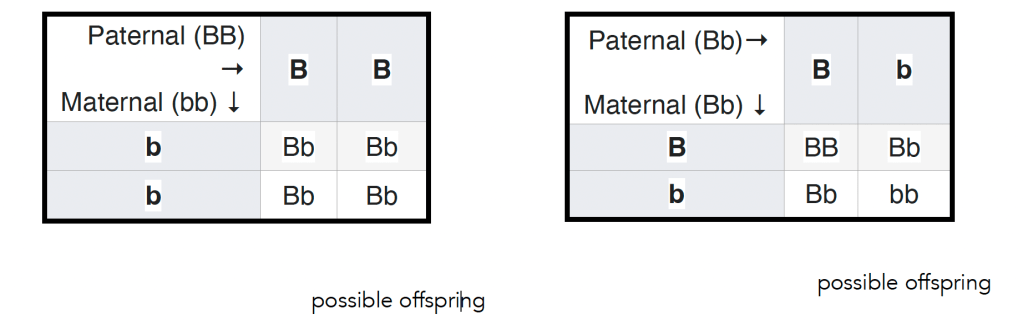
Another way students’ belief in genetic determinism can be reinforced is perhaps unintentional.  Typically the result of the original mating between homozygous recessive and dominant parents (the P generation) is termed the first filial or F1 generation. Often the next type of genetic cross presented to students involves crossing male and female F1 individuals to produce the second filial or F2 generation (see figure – right above ↑). Such as F1 cross is predicted to produce organisms that display the dominant to recessive trait in a ratio of 3 to 1.  What is often missing is that reproducible observation of this ratio requires that large numbers of F2 organisms are examined. The result of any particular F1 (heterozygous) cross is unpredictable; it can vary anywhere from 0 to 4 dominant to recessive trait displaying organisms to 4 to 0 trait dominant to recessive trait displaying organisms, and anything in between. This behavior is characteristic of a stochastic process; predictable when large numbers of events are considered and unpredictable when small numbers of events are considered.  Stochastic behaviors are common in biological organisms, given the small numbers of particular molecules, and specifically particular genes, they contain (a GoldLabSymposium talk on the topic).  In the context of organisms, there is room for something like “free will” (consideredhere).  Whether Elon “knows” he is giving something that closely resembles a Nazi salute or not, we can presume that he is, at least partially, responsible for his actions and by implication their ramifications.  

Why are the results of a mating stochastic?  Because which gamete contains which trait-associated allele occurs by chance, while which gametes fuse together to produce the embryo is again a chance event.  Some analyses of the numbers Mendel originally reported led to suggestions that his numbers were “too good”, and the perhaps he fudged them (for a good summary see Radick 2022).  The bottom line – subsequent studies have repeatedly confirmed Mendel’s conclusions with the important caution that the link between genotype and phenotype is typically complex and does not obey strictly deterministic rules.

Nota bene: This is not mean to be a lesson in genetics; if interested in going deeper I would recommend you read Jamieson & Radick (2013) and the genetics section of biofundamentals.  

Literature cited: 

Corvol et al., (2015). Genome-wide association meta-analysis identifies five modifier loci of lung disease severity in cystic fibrosis. Nature communications, 6, 8382. 

Curtis (2023). Mendel did not study common, naturally occurring phenotypes. Journal of Genetics, 102(2), 48.

Jamieson & Radick (2013). Putting Mendel in his place: How curriculum reform in genetics and counterfactual history of science can work together. In The philosophy of biology: A companion for educators (pp. 577-595). Dordrecht: Springer Netherlands.

Löscher (2024). Of Mice and Men: The Inter-individual Variability of the Brain’s Response to Drugs. Eneuro, 11(2).  

Nogler (2006). The lesser-known Mendel: his experiments on Hieracium. Genetics, 172(1), 1-6.

Radick (2022). Mendel the fraud? A social history of truth in genetics. Studies in History and Philosophy of Science, 93, 39-46. 

van Heyningen (2024). Stochasticity in genetics and gene regulation. Philosophical Transactions of the Royal Society B, 379(1900), 20230476.

Vogt et al., (2008). Production of different phenotypes from the same genotype in the same environment by developmental variation. Journal of Experimental Biology, 211, 510-523. 

Unexpected molecular sexual dimorphisms (in host mitochondrial-microbial interactions).

Unexpected molecular sexual dimorphisms (in host-microbial interactions).

While wandering through the literature, I found myself reading a paper by departmental colleagues Dong Tian, Mingxue Cui, and Min Han (2024).  They describe effects of bacterial mucopolysaccharides, components of bacterial cell walls, on mitochondrial functions in mice and human cells.  While an interesting example of the interaction between components of the microbiome and its host, what was particularly surprising to me was their observation that these mucopolysaccharides had sex-specific effects on mitochondrial functions (footnote 1).  This sexual dimorphism was documented by examining the generation of reactive oxygen species (ROS) formed during reactions involving molecular oxygen (O2),  concentrations of ATP (cells’ primary energy  currency), and body weight, when comparing control mice with mice treated with “an antibiotic cocktail to deplete the intestinal microbiota in order to eliminate the source of muropeptides following a well-established protocol for antibiotic-induced microbiome depletion (AIMD)”. One interesting result was that the addition of bacteria-derived proteoglycan derived “muropeptides” (see their figure 3 ↓ (modified) and the included image, derived from it with scale modifications) dramatically inhibited the effects of AIMD treatment on a number of cellular behaviors in mouse and human cells.    

Perhaps It should be expected that removing an organism’s internal microbiome causes a number of stress effects on the host, nor that mitochondria (derived, via endosymbiosis and subsequent evolutionary adaptations) respond to such changes.  Mitochondrial functions seem particularly sensitive to general cellular stresses (a topic considered in more detail in the appearance of mitochondrial stress effects  associated with “knock-out” mutations in a number of intermediate filament proteins (the work of others reviewed here). 

What was surprising (certainly to me) was the observation that male and female cells responded differently to muropeptides; something reported previously by Gabanyi et al (2022). There are, of course, a number of possible and plausible reasons for such differences. For one, a recent study of the cellular (gene-protein) network involved in male gamete formation further revealed its evolutionarily ancient origin and its complexity, involving the “expression of approximately 10,000 protein-coding genes, a third of which define a genetic scaffold of deeply conserved genes” (Brattig-Correia et al., 2024).  While this study focussed on the male germ lines, the tissue that generates sperm, it is likely that differences in gene expression occur throughout the body. As an example, based on analyses of protein expression in post-mortem human brain tissues Wingo et al (2023) reported that “Among the 1,239 proteins, 51% had higher expression in females and 49% had higher expression in males”.  

In this light, It is tempting to speculate that the effects of mucoproteins might well extend beyond the mouse and lead to sex-specific differences in humans as well.  The source of these differences could be the result of cellular and tissue specific differences sex-influenced variations in gene expression, protein activity, and cellular organization, including social interactions between cells in tissues and organs. They may arise as indirect (and complex) effects of androgen or estrogen-based  hormone responses.  It is interesting how these differences may or may not impact a range of physiological effects. 

Footnote

 Mitochondria are evolutionary derivatives of a bacterial endosymbiont(s) found in eukaryotes (organisms like us). For some background see Mitochondrial activity, embryogenesis, and the dialogue between the big and little brains of the cell.

literature cited:

Brattig-Correia et al., (2024). The conserved genetic program of male germ cells uncovers ancient regulators of human spermatogenesis. eLife, 13, RP95774.   

Gabanyi et al.'(2022). Bacterial sensing via neuronal Nod2 regulates appetite and body temperature. Science 376, eabj3986. .

Tian, D., Cui, M., & Han, M. (2024). Bacterial muropeptides promote OXPHOS and suppress mitochondrial stress in mammals. Cell reports, 43(4).

Wingo et al., (2023). Sex differences in brain protein expression and disease. Nature medicine, 29, 2224-2232.

Avoiding unrecognized racist implications arising from teaching genetics

Update to relevant article in the New York Times. December 2019

It is common to think of teaching as socially and politically beneficial, or at least benign, but Donovan et al. (2019. ” Toward a more humane genetics education” Science Education 103: 529-560)(1) raises the interesting possibility, supported by various forms of analysis and a thorough review of the literature, that conventional approaches to teaching genetics can exacerbate students’ racialist ideas. A focus on genetic diseases associated with various population groups, say for example Tay-Sachs disease within Eastern European Jewish populations of sickle cell anemia within African populations, can result in more racialist and racist perspectives among students.

What is meant by racialist? Basically it is an essentialist perspective that a person is an exemplar of the essence of a group, and that all members of a particular group “carry” that essence, an essence that defines them as different and distinct from members of other groups. Such an essence may reflect a culture, or in our more genetical age, their genome, that is the versions of the genes that they possess. In a sense, their essence is more real than their individuality, an idea that contradicts the core reality of biological systems, as outlined in works by Mayr (2,3) – a mistake he termed typological thinking.

Donovan et al. go on to present evidence that exposure of students to lessons that stress the genomic similarities between humans can help. That “any two humans share 99.9% of their DNA, which means that 0.1% of human DNA varies between individuals. Studies find that, on average, 4.3% of genetic variability in humans (4.3% of the 0.1% of the variable portion of human DNA) occurs between the continental populations commonly associated with US census racial groups (i.e., Africa, Asia, Pacific Islands, and The Americas, Europe). In contrast, 95.7% of human genetic variation (95.7% of the 0.1% of variable portion of human DNA) occurs between individuals within those same groups” (italics added). And that “there is more variability in skull shape, facial structure, and blood types within racially defined populations … than there is between them.” Lessons that emphasized the genomic similarities between people and the dissimilarities within groups, appeared effective in reducing racialist ideation – they can help dispel racist beliefs while presenting the most scientifically accurate information available.

This is of particular importance given the dangers of genetic essentialism, that is the idea that we are our genomes and that our genomes determine who (and what) we are. A pernicious ideology that even the co-discover of DNA’s structure, James Watson, has fallen prey to. One pernicious aspect of such conclusions is illustrated in the critique of a recent genomic analysis of educational attainment and cognitive performance by John Warner (4).

An interesting aspect of this work is to raise the question of where, within a curriculum, should genetics go? What are the most important aspects of the complex molecular-level interaction networks that connect genotype with phenotype that need to be included in order to flesh out the overly simplified Mendelian view (pure dominant and recessive alleles, monogenic traits, and unlinked genes) often presented? A point of particular relevance given the growing complexity of what genes are and how they act (5,6). Perhaps the serious consideration of genetic systems would be better left for later in a curriculum. At the very least, it points out the molecular and genomic contexts that should be included so as to minimize the inadvertent support for racialist predilections and predispositions. 

modified from F1000 post

References

  1. Donovan, B. M., R. Semmens, P. Keck, E. Brimhall, K. Busch, M. Weindling, A. Duncan, M. Stuhlsatz, Z. B. Bracey and M. Bloom (2019). “Toward a more humane genetics education: Learning about the social and quantitative complexities of human genetic variation research could reduce racial bias in adolescent and adult populations.” Science Education 103(3): 529-560.
  2. Mayr (1985) The Growth of Biological Thought: Diversity, Evolution, and Inheritance. Belknap Press of Harvard University Press ISBN: 9780674364462
  3. Mayr (1994) Typological versus population thinking. In: Conceptual issues in evolutionary biology. MIT Press, Bradford Books, 157-160. Sober E (ed)
  4. Why we shouldn’t embrace the genetics of education. Warner J. Inside Higher Ed blog, July 26 2018 Available online (accessed Aug 22 2019)
  5. Genes – way weirder than you thought. Bioliteracy blog, Jul 09 2018
  6. The evolving definition of the term “gene”. Portin & Wilkins. 2017 Genetics. 205:1353-1364

Remembering the past and recognizing the limits of science …

A recent article in the Guardian reports on a debate at University College London (1) on whether to rename buildings because the people honored harbored odious ideological and political positions. Similar debates and decisions, in some cases involving unacceptable and abusive behaviors rather than ideological positions, have occurred at a number of institutions (see Calhoun at Yale, Sackler in NYC, James Watson at Cold Spring Harbor, Tim Hunt at the MRC, and sexual predators within the National Academy of Sciences). These debates raise important and sometimes troubling issues.

When a building is named after a scientist, it is generally in order to honor that person’s scientific contributions. The scientist’s ideological opinions are rarely considered explicitly, although they may influence the decision at the time.  In general, scientific contributions are timeless in that they represent important steps in the evolution of a discipline, often by establishing a key observation, idea, or conceptual framework upon which subsequent progress is based – they are historically important.  In this sense, whether a scientific contribution was correct (as we currently understand the natural world) is less critical than what that contribution led to. The contribution marks a milestone or a turning point in a discipline, understanding that the efforts of many underlie disciplinary progress and that those contributors made it possible for others to “see further.” (2)

Since science is not about recognizing or establishing a single unchanging capital-T-Truth, but rather about developing an increasingly accurate model for how the world works, it is constantly evolving and open to revision.  Working scientists are not particularly upset when new observations lead to revisions to or the abandonment of ideas or the addition of new terms to equations.(3)

Compare that to the situation in the ideological, political, or religious realms.  A new translation or interpretation of a sacred text can provoke schism and remarkably violent responses between respective groups of believers. The closer the groups are to one another, the more horrific the levels of violence that emerge often are.  In contrast, over the long term, scientific schools of thought resolve, often merging with one another to form unified disciplines. From my own perspective, and not withstanding the temptation to generate new sub-disciplines (in part in response to funding factors), all of the life sciences have collapsed into a unified evolutionary/molecular framework.  All scientific disciplines tend to become, over time, consistent with, although not necessarily deducible from, one another, particularly when the discipline respects and retains connections to the real (observable) world.(4)  How different from the political and ideological.

The historical progression of scientific ideas is dramatically different from that of political, religious, or social mores.  No matter what some might claim, the modern quantum mechanical view of the atom bears little meaningful similarity to the ideas of the cohort that included Leucippus and Democritus.  There is progress in science.  In contrast, various belief systems rarely abandon their basic premises.  A politically right- or left-wing ideologue might well find kindred spirits in the ancient world.  There were genocidal racists, theists, and nationalists in the past and there are genocidal racists, theists, and nationalists now.  There were (limited) democracies then, as there are (limited) democracies now; monarchical, oligarchical, and dictatorial political systems then and now; theistic religions then and now. Absolutist ideals of innate human rights, then as now, are routinely sacrificed for a range of mostly self-serving or politically expedient reasons.  Advocates of rule by the people repeatedly install repressive dictatorships. The authors of the United States Constitution declare the sacredness of human rights and then legitimized slavery. “The Bible … posits universal brotherhood, then tells Israel to kill all the Amorites.” (Phil Christman). The eugenic movement is a good example; for the promise of a genetically perfect future, existing people are treated inhumanely – just another version of apocalyptic (ends justify the means) thinking. 

Ignoring the simpler case of not honoring criminals (sexual and otherwise), most calls for removing names from buildings are based on the odious ideological positions espoused by the honored – typically some version of racist, nationalistic, or sexist ideologies.  The complication comes from the fact that people are complex, shaped by the context within which they grow up, their personal histories and the dominant ideological milieu they experienced, as well as their reactions to it.  But these ideological positions are not scientific, although a person’s scientific worldview and their ideological positions may be intertwined. The honoree may claim that science “says” something unambiguous and unarguable, often in an attempt to force others to acquiesce to their perspective.  A modern example would be arguments about whether climate is changing due to anthropogenic factors, a scientific topic, and what to do about it, an economic, political, and perhaps ideological question.(5)

So what to do?  To me, the answer seems reasonably obvious – assuming that the person’s contribution was significant enough, we should leave the name in place and use the controversy to consider why they held their objectionable beliefs and more explicitly why they were wrong to claim scientific justification for their ideological (racist / nationalist / sexist / socially prejudiced) positions.(6)  Consider explicitly why an archeologist (Flinders Petrie), a naturalist (Francis Galton), a statistician (Karl Pearson), and an advocate for women’s reproductive rights (Marie Stopes) might all support the non-scientific ideology of eugenics and forced sterilization.  We can use such situations as a framework within which to delineate the boundaries between the scientific and the ideological. 

Understanding this distinction is critical and is one of the primary justifications for why people not necessarily interested in science or science-based careers are often required to take science courses.  Yet all too often these courses fail to address the constraints of science, the difference between political and ideological opinions, and the implications of scientific models.  I would argue that unless students (and citizens) come to understand what constitutes a scientific idea or conclusion and what reflects a political or ideological position couched in scientific or pseudo-scientific terms, they are not learning what they need to know about science or its place in society.  That science is used as a proxy for Truth writ large is deeply misguided. It is much more important to understand how science works than it is to remember the number of phyla or the names of amino acids, the ability to calculate the pH of a solution, or to understand processes going on at the center of a galaxy or the details of a black hole’s behavior.  While sometimes harmless, misunderstanding science and how it is used socially can result in traumatic social implications, such as drawing harmful conclusions about individuals from statistical generalizations of populations, avoidable deaths from measles, and the forced “eugenic” sterilization of people deemed defective.  We should seek out and embrace opportunities to teach about these issues, even if it means we name buildings after imperfect people.  

footnotes:

  1. The location of some of my post-doc work.
  2. In the words of Isaac Newton, “If I have seen further than others, it is by standing upon the shoulders of giants.”
  3.  Unless, of course, the ideas and equations being revised or abandoned are one’s own. 
  4.  Perhaps the most striking exception occurs in physics on the subjects of quantum mechanics and relativity, but as I am not a physicist, I am not sure about that. 
  5.  Perhaps people are “meant” to go extinct. 
  6.  The situation is rather different outside of science, because the reality of progress is more problematic and past battles continue to be refought.  Given the history of Reconstruction and the Confederate “Lost Cause” movement [see PBS’s Reconstruction] following the American Civil War, monuments to defenders of slavery, no matter how admirable they may have been in terms of personal bravery and such, reek of implied violence, subjugation, and repression, particularly when the person honored went on to found an institution dedicated to racial hatred and violent intimidation [link]. There would seem little doubt that a monument in honor of a Nazi needs to be eliminated and replaced by one to their victims or to those who defeated them.