W. F. R. Weldon’s Critique of Mendel’s Work: Biological Relevance and Context. 

A RAG-ChatGPT written backgrounder (checked and edited by Mike Klymkowsky ) for the excessively curious – in support of biofundamentals – 1 August 2025

Weldon’s Background and Perspective: Walter F. R. Weldon (1860–1906) was a British zoologist and a pioneer of biometry – the statistical study of biological variation. He believed that evolution operated through numerous small, continuous variations rather than abrupt, either-or traits. In his studies of creatures like shrimps and crabs, Weldon found that even traits which appeared dimorphic at first could grade into one another when large enough samples were measured [link]. He and his colleague Karl Pearson (1857-1936) argued that Darwin’s theory of natural selection was best tested with quantitative methods: “the questions raised by the Darwinian hypothesis are purely statistical, and the statistical method is the only one at present obvious by which that hypothesis can be experimentally checked” [link]. This emphasis on gradual variation and statistical analysis set Weldon at odds with the emerging Mendelian school of genetics, led by William Bateson (1861-1926) that focused on discrete traits and sudden changes. By 1902, the scientific community had split into two camps – the biometricians (Weldon and Pearson in London) versus the Mendelians (Bateson and allies in Cambridge) – reflecting deep disagreements over the nature of heredity [link]. This was the charged backdrop against which Weldon evaluated Gregor Mendel’s pea-breeding experiments.

Critique of Mendel’s Pea Traits and Categories Weldon’s photographic plate of peas illustrating continuous variation in seed color. (This figure from his 1902 paper shows pea seeds ranging from green to yellow in a smooth gradient, contradicting the clear-cut “green vs. yellow” categories assumed by Mendel [link]. Images 1–6 and 7–12 (top rows) display the range of cotyledon colors in two different pea varieties after the seed coats were removed [link]. Instead of all seeds being simply green or yellow, Weldon documented many intermediate shades. He even found seeds whose two cotyledons (halves) differed in color, underscoring that Mendel’s binary categories were oversimplifications of a more complex reality [link].

Weldon closely re-examined the seven pea traits Mendel had chosen (such as seed color and seed shape) and argued that Mendel’s tidy classifications did not reflect biological reality in peas. In Mendel’s account, peas were either “green” or “yellow” and produced either “round, smooth” or “wrinkled” seeds, with nothing in between. Weldon showed this was an artifact of Mendel’s experimental design. He gathered peas from diverse sources and found continuous variation rather than strict binary types. For example, a supposedly pure “round-seeded” variety produced seeds with varying degrees of roundness and wrinkling [link]. Likewise, seeds that would be classified as “green” or “yellow” in Mendel’s scheme actually exhibited a spectrum of color tones from deep green through greenish-yellow to bright yellow [link]. Weldon’s observations were impossible to reconcile with a simple either/or trait definition [link].

Weldon concluded that Mendel had deliberately picked atypical pea strains with stark, discontinuous traits, and that Mendel’s category labels (e.g. “green vs. yellow” seeds) obscured the true, much more variable nature of those characters [link]. In Weldon’s view, the neat ratios Mendel obtained were only achievable because Mendel worked with artificially generated lines of peas, bred to eliminate intermediate forms [link]. In ordinary pea populations that a farmer or naturalist might encounter, such clear-cut divisions virtually disappeared: “Many races of peas are exceedingly variable, both in colour and in shape,” Weldon noted, “so that both the category ‘round and smooth’ and the category ‘wrinkled and irregular’ include a considerable range of varieties.” [link] In short, he felt Mendel’s chosen traits were too simple and unrepresentative. The crisp binary traits in Mendel’s experiments were the exception, not the rule, in nature. Weldon’s extensive survey of pea varieties led him to believe that Mendel’s results “had no validity beyond the artificially “purified”in-bred” races Mendel worked with,” because the binary categories “obscured a far more variable reality.”[link]

Mendel’s Conclusions and Real-World Heredity. Weldon went beyond critiquing Mendel’s choice of traits – he questioned whether Mendel’s conclusions about heredity were biologically meaningful for understanding inheritance in real populations. Based on his empirical findings and evolutionary perspective, Weldon doubted that Mendel’s laws could serve as general laws of heredity. Some of his major biological objections were:

Traits are seldom purely binary in nature: Outside the monk’s garden, most characteristics do not sort into a few discrete classes. Instead, they form continuous gradations. Weldon realized that Mendel’s insistence on traits segregating neatly into “either/or” categories “simply wasn’t true,” even for peas [link]. Mendel’s clear ratios were achieved by excluding the normal range of variation; in the wild, peas varied continuously from yellow to green with every shade in between [link]. What Mendel presented as unitary “characters” were, in Weldon’s eyes, extremes picked from a continuum.

Mendel’s results were an artifact of pure-breeding: Weldon argued that the famous 3:1 ratios and other patterns were only apparent because Mendel had used highly inbred, “pure” varieties. By extensive inbreeding and selection, Mendel stripped away intermediate variants [link]. The artificially uniform parent strains used in Mendel’s experiments do not reflect natural populations. Weldon concluded that the seeming universality of Mendel’s laws was misleading – they described those special pea strains, not peas (or other organisms) at large [link]. In a letter, he even mused whether Mendel’s remarkably clean data were “too good” to be true, hinting that real-world data would rarely align so perfectly [link].

Dominance is not an absolute property: A cornerstone of Mendelism was that one trait form is dominant over the other (e.g. yellow dominates green). Weldon questioned this simplistic view. He gathered evidence that whether a given trait appears dominant or recessive can depend on context – on the plant’s overall genetic background and environmental conditions [link]. For example, a seed color might behave as dominant in one cross but not in another, if other genetic factors differ. Weldon argued that Mendel’s concept of dominance was “oversimplified” because it treated dominance as inherent to a trait, independent of development or ancestry [link]. In reality (as Weldon emphasized), “the effect of the same bit of chromosome can be different depending on the hereditary background and the wider environmental conditions”, so an inherited character’s expression isn’t fixed as purely dominant or recessive [link]. This questioned the biological generality of Mendel’s one-size-fits-all dominance rule.

Atavism and ancestral influence: Perhaps most intriguing was Weldon’s concern with reversion (atavism) – cases where an offspring exhibits a trait of a distant ancestor that had seemingly disappeared in intervening generations. Breeders of plants and animals had long reported that occasionally a “throwback” individual would appear, showing an old parental form or color after many generations of absence. To Weldon, such phenomena implied that heredity isn’t solely about the immediate parents’ genes, but can be influenced by more remote ancestral contributions [link]. “Mendel treats such characters as if the condition in two given parents determined the condition in all their offspring,” Weldon wrote, but breeders know that “the condition of an organism does not as a rule depend upon [any one pair of ancestors] alone, but in varying degrees upon the condition of all its ancestors in every past generation” [link]. In other words, the influence of a trait could accumulate or skip generations. This idea directly conflicted with Mendel’s theory as presented in 1900, which only considered inheritance from the two parents and had no mechanism for latent ancestral traits resurfacing after several generations. Weldon concluded from examples of reversion that Mendel’s framework was biologically incomplete – there had to be “more going on” in heredity than Mendel’s laws acknowledged [link].

In sum, Weldon found Mendel’s laws too limited and idealized to account for the messy realities of inheritance in natural populations. Mendel had demonstrated elegant numerical ratios with a few pea characters, but Weldon did not believe those results scaled up to the complex heredity of most traits or species. Variation, continuity, and context were central in Weldon’s view of biology, whereas Mendel’s work (as interpreted by Mendel’s supporters) seemed to ignore those factors. Thus, Weldon saw Mendel’s conclusions as at best a special case – interesting, but not the whole story of heredity in the real world [link][link].

Weldon’s Legacy

Weldon’s critiques came at a time of intense debate between the “Mendelians” and the “Biometricians.” William Bateson, the chief Mendelian, vehemently defended Mendel’s theory against Weldon’s attacks. In 1902, Bateson published a lengthy rebuttal titled Mendel’s Principles of Heredity: A Defense, including a 100-page polemic aimed squarely at “defending Mendel from Professor Weldon”[link]. Bateson and his allies believed Weldon had misinterpreted Mendel and that discrete Mendelian factors really were the key to heredity. The clash between Weldon and Bateson grew increasingly personal and public. By 1904 the feud had become so heated that the editor of Nature refused to publish any further exchanges between the two sides [link]. At a 1904 British Association meeting, a debate between Bateson and Weldon on evolution and heredity became a shouting match, emblematic of how divisive the issue had become [link][link].

Although Weldon’s objections were rooted in biological observations, many contemporaries saw the dispute as one of old guard vs. new ideas. Tragically, Weldon died in 1906 at the age of 46, with a major manuscript on inheritance still unfinished [link]. In that unpublished work, he had gathered experimental data to support a more nuanced theory reconciling heredity with development and ancestral effects [link][link]. With his early  death, much of Weldon’s larger critique faded from the spotlight. Mendelian genetics, championed by Bateson and later enriched by the chromosome theory, surged ahead. Nevertheless, in hindsight many of Weldon’s points were remarkably prescient. His insistence on looking at population-level variation and the importance of multiple factors and environment foreshadowed the modern understanding that Mendelian genes can interact in complex ways (for example, polygenic inheritance and gene-by-environment effects). As one historian noted, Weldon’s critiques of Mendelian principles were “100 years ahead of his time” [link]. In the context of his era, Weldon doubted the biological relevance of Mendel’s peas for the broader canvas of life – and while Mendel’s laws did prove fundamental, Weldon was correct that real-world heredity is more intricate than simple pea traits. His challenge to Mendelism ultimately pushed geneticists to grapple with continuous variation and population dynamics, helping lay the groundwork for the synthesis of Mendelian genetics with biometry in the decades after his death[link][link].

Sources: Weldon’s 1902 paper in Biometrika and historical analyses [link][link][link][link][link][link][link]provide the basis for the above summary. These document Weldon’s arguments that Mendel’s pea traits were overly simplistic and his laws of heredity not universally applicable to natural populations, especially in light of continuous variation, context-dependent trait expression, and atavistic reversions. The debate between Weldon and the Mendelians is detailed in contemporary accounts and later historical reviews [link][link], illustrating the scientific and conceptual rift that formed around Mendel’s rediscovered work.
Introductory genetics: one way by which determinism creeps into biology students’ heads.

background: I have long been interested in students’ (and the public’s) misconceptions about biology (see this & that).  More and more, it appears to me that part of the problem arises when conventional biology (and science courses in general) leave underlying scientific principles unrecognized and/or unexplained.  In biology, there is a understandable temptation to present processes in simple unambiguous ways, often by ignoring the intrinsic complexity and underlying molecular scale of these systems. The result is widespread confusion among the public, a confusion often exploited by various social “influencers”, some (rather depressingly) currently in positions of power within the US.  

After attending a recent Ray Troll and Kirk Johnson roadshow on fossils, art, and public engagement at the Denver Museum of Nature and Science (DMNS), I got to thinking. As a new hobby, in advance of retirement, perhaps I can work on evolving the tone of my writing to become less “academical” and more impactful, engaging, and entertaining (at least to some) while staying scientifically accurate and comprehensible. So here goes an attempt (helped out by genAI).

A common misconception, promoted by some “science popularizers” is that biological systems, including humans, are “determined” or “super-determined” (what ever that means) by various factors, particularly by the versions of genes, known as alleles, they inherited from their parents.  While there is no question that biological systems are influenced and constrained by a number of factors (critical to “stay’n alive), the idea of determinism seems problematic (considered here).  So where would a belief in biological determinism come from?  One possibility, that emerged in the “Teaching and Learning Biology” course taught with Will Lindsay@CU Boulder, is the way basic genetics is often presented to students. The specific topic that caught my attention was the way the outcome of genetic crosses (matings) was presented, specifically through the use of what are known as Punnett’s squares.

In a typical sexually reproducing organism, the parents with different mating types or sexes, e.g. male and female, have two copies of each gene (mostly) – they are termed “diploid”.  The two versions of a particular gene can be the same, in which case the organism is said to be “homozygous” or different, when it is termed “heterozygous” for that gene. The allele(s) carried by one parent can be the same or different from the allele(s) carried by the other. Molecular analysis of the alleles present in a population has been key to determining who, back in the day, was mating with Neanderthals (see wikipedia). Each gamete (egg or sperm) produced contains one or the other version of each gene – they are termed “haploid”.  When sperm and egg fuse, a new diploid organism is generated. 

Much of what is described above was figured out by Gregor Mendel (wikipedia).  The good monk employed a few tricks that enabled him to recognize (deduce) key genetic “rules”.  First, he worked with peas, Pisum sativum and related species. He used plants grown by commercial plant breeders to have specific versions of a particular trait.  In his studies, he focussed on plants that displayed versions of traits that were unambiguously distinguishable from one another. Such pairs of traits are termed dichotomous; they exist in one or the other unambiguously recognizable form, without overlapping intermediates. The majority of traits are continuous rather than dichotomous.   

As part of the process of generating “predictable plants”, breeders select male and female plants with the traits that they seek and discard others.  After many generations the result are plants with reproducible and predictable traits. Does this mean that the plants are identical?  Nope!  There is still variability between individual plants of the same “strain”.  For example, Mendel used strains of “tall” and “short” pea plants; the tall plants had stem lengths of between ~6 to 7 feet while the short plants had stem lengths between ~0.75 to 1.5 feet (a two-fold variation)(see Curtis, 2023). He put them into tall and short classes, ignoring these differences. But these plants were different.  Such differences arise through stochastic processes and responses to developmental and environmental effects that impact height in various ways (discussed in a past post). Mendel began his studies with 22 strains of pea plants but only 7 exhibited the dichotomous behaviors he wanted. If he had included the others, it is likely he would have been confused and never would have arrived at his clean genetic rules. In fact, after he published his studies on peas, he took the advice of Carl Nägeli (see wikipedia) and began studies using Hieracium (hawkweeds), which differs in its reproductive strategy from Pisum (Nogler 2006). Nägeli’s suggestion and Mendel studies lead to uncertainty about the universality of Mendel’s rules. Mendel’s experiences reflect a key feature of scientific studies: simplify, get interpretable data, and then extend observations / systems leading to confirmation or revision. 

The variation inherent in biological systems is nicely illustrated by what is (or should be) a classic study by Vogt et al (2008) who described the variations that occur within populations of genetically identical shrimp raised in identical conditions. The variation between genetically similar organisms (or identical twins) found in the wild (natural populations) is much greater.  Why? because in breeder supplied plants most of the allelic variation present in the wild population is lost, discarded in the process of selecting and breeding organisms for specific traits. We see these “genetic background” effects when looking at genetically determined traits in humans as well. Consider cystic fibrous, a human genetic disease associated with the inheritance of altered versions of the CFTR gene (more on cystic fibrosis). People who inherit two disease-associated alleles of the CFTR gene develop cystic fibrosis, but as noted by Corvol et al (2015) “patients who have the same variants in CFTR exhibit substantial variation in the severity of lung disease” and this variation is associated (explained by) genetic background effects, together with stochastic effects and their developmental and environmental histories.  In any of a number of studies, whenever  populations of organisms are analyzed based on their genotype (which alleles they carry) the result is inevitably a distribution of responses, even when the average responses are different (for a good example see Löscher 2024).

In the case of the traits Mendel studied, he concluded that the trait was determined by the presence of different versions (alleles) of a genetic “factor”, that each organism contained two alleles, that these alleles could be the same (homozygous) or different (heterozygous), and that one allele was “dominant” to the other (“recessive”).  If the dominant allele were present, it would determine the form of the trait observed.  Only if both versions of the alleles present were recessive would the organism display the associated trait. The other rule was that all of the gametes produced by homozygous organism carried the same “trait-producing” allele, while heterozygous organisms produced gametes containing one or the other allele.   

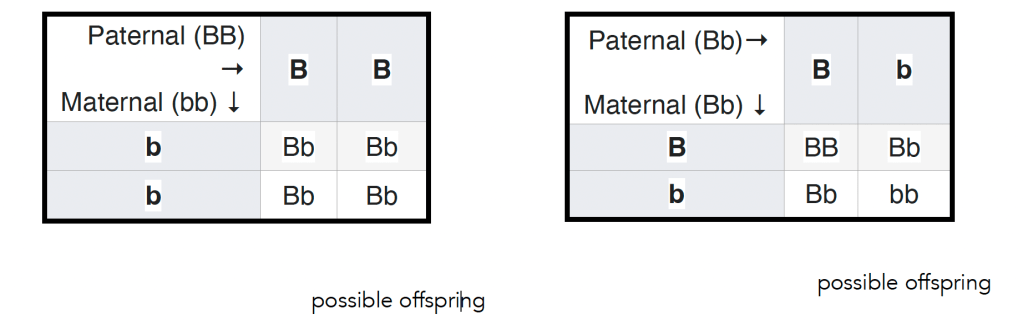
In 1905 Reginald Punnett introduced a way of thinking about Mendel’s matings, a diagram now known as a Punnett’s square (see wikipedia).  In this figure (left below) ↓ the outcome of a mating between a male homozygous for a dominant allele and a female homozygous for a recessive allele is illustrated.  All of the offspring will be heterozygous, but it is worth keeping in mind, however, that does not mean that they will be identical – they will display a similar level of variation in the trait seen in populations of the parental plants (see above).  Again, this variation arises from the impact of environmental effects on developmental processes together with the influence of stochastic effects. The variation associated with the particular set of alleles present in an organism is captured by what is known as variable penetrance and expressivity of a gene-influenced trait (see link for molecular details).  Ignoring the variations observed between organisms carrying the same allele(s) of a gene (or the same genotype in identical twins or clones can encourage or reinforce the idea that the details of an organism (its phenotype) are determined by the alleles it carries.    

Another way students’ belief in genetic determinism can be reinforced is perhaps unintentional.  Typically the result of the original mating between homozygous recessive and dominant parents (the P generation) is termed the first filial or F1 generation. Often the next type of genetic cross presented to students involves crossing male and female F1 individuals to produce the second filial or F2 generation (see figure – right above ↑). Such as F1 cross is predicted to produce organisms that display the dominant to recessive trait in a ratio of 3 to 1.  What is often missing is that reproducible observation of this ratio requires that large numbers of F2 organisms are examined. The result of any particular F1 (heterozygous) cross is unpredictable; it can vary anywhere from 0 to 4 dominant to recessive trait displaying organisms to 4 to 0 trait dominant to recessive trait displaying organisms, and anything in between. This behavior is characteristic of a stochastic process; predictable when large numbers of events are considered and unpredictable when small numbers of events are considered.  Stochastic behaviors are common in biological organisms, given the small numbers of particular molecules, and specifically particular genes, they contain (a GoldLabSymposium talk on the topic).  In the context of organisms, there is room for something like “free will” (consideredhere).  Whether Elon “knows” he is giving something that closely resembles a Nazi salute or not, we can presume that he is, at least partially, responsible for his actions and by implication their ramifications.  

Why are the results of a mating stochastic?  Because which gamete contains which trait-associated allele occurs by chance, while which gametes fuse together to produce the embryo is again a chance event.  Some analyses of the numbers Mendel originally reported led to suggestions that his numbers were “too good”, and the perhaps he fudged them (for a good summary see Radick 2022).  The bottom line – subsequent studies have repeatedly confirmed Mendel’s conclusions with the important caution that the link between genotype and phenotype is typically complex and does not obey strictly deterministic rules.

Nota bene: This is not mean to be a lesson in genetics; if interested in going deeper I would recommend you read Jamieson & Radick (2013) and the genetics section of biofundamentals.  

Literature cited: 

Corvol et al., (2015). Genome-wide association meta-analysis identifies five modifier loci of lung disease severity in cystic fibrosis. Nature communications, 6, 8382. 

Curtis (2023). Mendel did not study common, naturally occurring phenotypes. Journal of Genetics, 102(2), 48.

Jamieson & Radick (2013). Putting Mendel in his place: How curriculum reform in genetics and counterfactual history of science can work together. In The philosophy of biology: A companion for educators (pp. 577-595). Dordrecht: Springer Netherlands.

Löscher (2024). Of Mice and Men: The Inter-individual Variability of the Brain’s Response to Drugs. Eneuro, 11(2).  

Nogler (2006). The lesser-known Mendel: his experiments on Hieracium. Genetics, 172(1), 1-6.

Radick (2022). Mendel the fraud? A social history of truth in genetics. Studies in History and Philosophy of Science, 93, 39-46. 

van Heyningen (2024). Stochasticity in genetics and gene regulation. Philosophical Transactions of the Royal Society B, 379(1900), 20230476.

Vogt et al., (2008). Production of different phenotypes from the same genotype in the same environment by developmental variation. Journal of Experimental Biology, 211, 510-523. 

Unexpected molecular sexual dimorphisms (in host mitochondrial-microbial interactions).

Unexpected molecular sexual dimorphisms (in host-microbial interactions).

While wandering through the literature, I found myself reading a paper by departmental colleagues Dong Tian, Mingxue Cui, and Min Han (2024).  They describe effects of bacterial mucopolysaccharides, components of bacterial cell walls, on mitochondrial functions in mice and human cells.  While an interesting example of the interaction between components of the microbiome and its host, what was particularly surprising to me was their observation that these mucopolysaccharides had sex-specific effects on mitochondrial functions (footnote 1).  This sexual dimorphism was documented by examining the generation of reactive oxygen species (ROS) formed during reactions involving molecular oxygen (O2),  concentrations of ATP (cells’ primary energy  currency), and body weight, when comparing control mice with mice treated with “an antibiotic cocktail to deplete the intestinal microbiota in order to eliminate the source of muropeptides following a well-established protocol for antibiotic-induced microbiome depletion (AIMD)”. One interesting result was that the addition of bacteria-derived proteoglycan derived “muropeptides” (see their figure 3 ↓ (modified) and the included image, derived from it with scale modifications) dramatically inhibited the effects of AIMD treatment on a number of cellular behaviors in mouse and human cells.    

Perhaps It should be expected that removing an organism’s internal microbiome causes a number of stress effects on the host, nor that mitochondria (derived, via endosymbiosis and subsequent evolutionary adaptations) respond to such changes.  Mitochondrial functions seem particularly sensitive to general cellular stresses (a topic considered in more detail in the appearance of mitochondrial stress effects  associated with “knock-out” mutations in a number of intermediate filament proteins (the work of others reviewed here). 

What was surprising (certainly to me) was the observation that male and female cells responded differently to muropeptides; something reported previously by Gabanyi et al (2022). There are, of course, a number of possible and plausible reasons for such differences. For one, a recent study of the cellular (gene-protein) network involved in male gamete formation further revealed its evolutionarily ancient origin and its complexity, involving the “expression of approximately 10,000 protein-coding genes, a third of which define a genetic scaffold of deeply conserved genes” (Brattig-Correia et al., 2024).  While this study focussed on the male germ lines, the tissue that generates sperm, it is likely that differences in gene expression occur throughout the body. As an example, based on analyses of protein expression in post-mortem human brain tissues Wingo et al (2023) reported that “Among the 1,239 proteins, 51% had higher expression in females and 49% had higher expression in males”.  

In this light, It is tempting to speculate that the effects of mucoproteins might well extend beyond the mouse and lead to sex-specific differences in humans as well.  The source of these differences could be the result of cellular and tissue specific differences sex-influenced variations in gene expression, protein activity, and cellular organization, including social interactions between cells in tissues and organs. They may arise as indirect (and complex) effects of androgen or estrogen-based  hormone responses.  It is interesting how these differences may or may not impact a range of physiological effects. 

Footnote

 Mitochondria are evolutionary derivatives of a bacterial endosymbiont(s) found in eukaryotes (organisms like us). For some background see Mitochondrial activity, embryogenesis, and the dialogue between the big and little brains of the cell.

literature cited:

Brattig-Correia et al., (2024). The conserved genetic program of male germ cells uncovers ancient regulators of human spermatogenesis. eLife, 13, RP95774.   

Gabanyi et al.'(2022). Bacterial sensing via neuronal Nod2 regulates appetite and body temperature. Science 376, eabj3986. .

Tian, D., Cui, M., & Han, M. (2024). Bacterial muropeptides promote OXPHOS and suppress mitochondrial stress in mammals. Cell reports, 43(4).

Wingo et al., (2023). Sex differences in brain protein expression and disease. Nature medicine, 29, 2224-2232.

Genes – way weirder than you thought

Pretty much everyone, at least in societies with access to public education or exposure to media in its various forms, has been introduced to the idea of the gene, but “exposure does not equate to understanding” (see Lanie et al., 2004).  Here I will argue that part of the problem is that instruction in genetics (or in more modern terms, the molecular biology of the gene and its role in biological processes) has not kept up with the advances in our understanding of the molecular mechanisms underlying biological processes (Gayon, 2016). spacer bar

Let us reflect (for a moment) on the development of the concept of a gene: Over the course of human history, those who have been paying attention to such things have noticed that organisms appear to come in “types”, what biologists refer to as species. At the same time, individual organisms of the same type are not identical to one  another, they vary in various ways. Moreover, these differences can be passed from generation to generation, and by controlling  which organisms were bred together; some of the resulting offspring often displayed more extreme versions of the “selected” traits.  By strictly controlling which individuals were breddogs
together, over a number of generations, people were able to select for the specific traits they desired (→).  As an interesting aside, as people domesticated animals, such as cows and goats, the availability of associated resources (e.g. milk) led to reciprocal effects – resulting in traits such as adult lactose tolerance (see Evolution of (adult) lactose tolerance & Gerbault et al., 2011).  Overall, the process of plant and animal breeding is generally rather harsh (something that the fanciers of strange breeds who object to GMOs might reflect upon), in that individuals that did not display the desired trait(s) were generally destroyed (or at best, not allowed to breed). spacer bar

Charles Darwin took inspiration from this process, substituting “natural” for artificial (human-determined) selection to shape populations, eventually generating new species (Darwin, 1859).  Underlying such evolutionary processes was the presumption that traits, and their variation, was “encoded” in some type of “factors”, eventually known as genes and their variants, alleles.  Genes influenced the organism’s molecular, cellular, and developmental systems, but the nature of these inheritable factors and the molecular trait building machines active in living systems was more or less completely obscure. 

Through his studies on peas, Gregor Mendel was the first to clearly identify some of the rules for the behavior of these inheritable factors using highly stereotyped, and essentially discontinuous traits – a pea was either yellow or green, wrinkled or smooth.  Such traits, while they exist in other organisms, are in fact rare – an example of how the scientific exploration of exceptional situations can help understand general processes, but the downside is the promulgation of the idea that genes and traits are somehow discontinuous – that a trait is yes/no, displayed by an organism or not – in contrast to the realities that the link between the two is complex, a reality rarely directly addressed (apparently) in most introductory genetics courses.  Understanding such processes is critical to appreciating the fact that genetics is often not destiny, but rather alterations in probabilities (see Cooper et al., 2013).  Without such an more nuanced and realistic understanding, it can be difficult to make sense of genetic information.     spacer bar

A gene is part of a molecular machine:  A number of observations transformed the abstraction of Darwin’s and Mendel’s hereditary factors into physical entities and molecular mechanisms (1).  In 1928 Fred Griffith demonstrated that a genetic trait could be transferred from dead to living organisms – implying a degree of physical / chemical stability; subsequent observations implied that the genetic information transferred involved DNA molecules. The determination of the structure of double-stranded DNA immediately suggested how information could be stored in DNA (in variations of bases along the length of the molecule) and how this information could be duplicated (based on the specificity of base pairing).  Mutations could be understood as changes in the sequence of bases along a DNA molecule (introduced by chemicals, radiation, mistakes during replication, or molecular reorganizations associated with DNA repair mechanisms and selfish genetic elements.  

But on their own, DNA molecules are inert – they have functions only within the context of a living organism (or highly artificial, that is man made, experimental systems).  The next critical step was to understand how a gene works within a biological system, that is, within an organism.  This involve appreciating the molecular mechanisms (primarily proteins) involved in identifying which stretches of a particular DNA molecule were used as templates for the synthesis of RNA molecules, which in turn could be used to direct the synthesis of polypeptides (see previous post on polypeptides and proteins).  In the context of the introductory biology courses I am familiar with (please let me know if I am wrong), these processes are based on a rather deterministic context; a gene is either on or off in a particular cell type, leading to the presence or absence of a trait. Such a deterministic presentation ignores the stochastic nature of molecular level processes (see past post: Biology education in the light of single cell/molecule studies) and the dynamic interaction networks that underlie cellular behaviors.  spacer bar

But our level of resolution is changing rapidly (2).  For a number of practical reasons, when the human genome was first sequence, the identification of polypeptide-encoding genes was based on recognizing “open-reading frames” (ORFs) encoding polypeptides of > 100 amino acids in length (> 300 base long coding sequence).  The increasing sensitivity of mass spectrometry-based proteomic studies reveals that smaller ORFs (smORFs) are present and can lead to the synthesis of short (< 50 amino acid long) polypeptides (Chugunova et al., 2017; Couso, 2015).  Typically an ORF was considered a single entity – basically one gene one ORF one polypeptide (3).  A recent, rather surprising discovery is what are known as “alternative ORFs” or altORFs; these RNA molecules that use alternative reading frames to encode small polypeptides.  Such altORFs can be located upstream, downstream, or within the previously identified conventional ORFalternative orfs
(figure →)(see Samandi et al., 2017).  The implication, particularly for the analysis of how variations in genes link to traits, is that a change, a mutation or even the  experimental  deletion of a gene, a common approach in a range of experimental studies, can do much more than previously presumed – not only is the targeted ORF effected, but various altORFs can also be modified.  

The situation is further complicated when the established rules of using RNAs to direct polypeptide synthesis via the process of translation, are violated, as occurs in what is known as “repeat-associated non-ATG (RAN)” polypeptide synthesis (see Cleary and Ranum, 2017).  In this situation, the normal signal for the start of RNA-directed polypeptide synthesis, an AUG codon, is subverted – other RNA synthesis start sites are used leading to underlying or imbedded gene expression.  This process has been found associated with a class of human genetic diseases, such as amyotrophic lateral sclerosis (ALS) and frontotemporal dementia (FTD) characterized by the expansion of simple (repeated) DNA sequences  (see Pattamatta et al., 2018).  Once they exceed a certain length, such“repeat” regions have been found to be associated with the (apparently) inappropriarepeat region RAN process
te transcription of RNA in both directions, that is using both DNA strands as templates (← A: normal situation, B: upon expansion of the repeat domain).  These abnormal repeat region RNAs are translated via the RAN process to generate six different types of toxic polypeptides. spacer bar

So what are the molecular factors that control the various types of altORF transcription and translation?  In the case of ALS and FTD, it appears that other genes, and the polypeptides and proteins they encode, are involved in regulating the expression of repeat associated RNAs (Kramer et al., 2016)(Cheng et al., 2018).  Similar or distinct mechanisms may be involved in other  neurodegenerative diseases  (Cavallieri et al., 2017).  

So how should all of these molecular details (and it is likely that there are more to be discovered) influence how genes are presented to students?  I would argue that DNA should be presented as a substrate upon which various molecular mechanisms occur; these include transcription in its various forms (directed and noisy), as well as DNA synthesis, modification, and repair mechanisms occur.   Genes are not static objects, but key parts of dynamic systems.  This may be one reason that classical genetics, that is genes presented within a simple Mendelian (gene to trait) framework, should be moved deeper into the curriculum, where students have the background in molecular mechanisms needed to appreciate its complexities, complexities that arise from the multiple molecular machines acting to access, modify, and use the information captured in DNA (through evolutionary processes), thereby placing the gene in a more realistic cellular perspective (4). 

Footnotes:

1. Described greater detail in biofundamentals™

2. For this discussion, I am completely ignoring the roles of genes that encode RNAs that, as far as is currently know, do not encode polypeptides.  That said, as we go on, you will see that it is possible that some such non-coding RNA may encode small polypeptides.  

3. I am ignoring the complexities associated with alternative promoter elements, introns, and the alternative and often cell-type specific regulated splicing of RNAs, to create multiple ORFs from a single gene.  

4. With respects to Norm Pace – assuming that I have the handedness of the DNA molecules wrong or have exchanged Z for A or B. 

literature cited: 

  • Cavallieri et al, 2017. C9ORF72 and parkinsonism: Weak link, innocent bystander, or central player in neurodegeneration? Journal of the neurological sciences 378, 49.
  • Cheng et al, 2018. C9ORF72 GGGGCC repeat-associated non-AUG translation is upregulated by stress through eIF2α phosphorylation. Nature communications 9, 51.
  • Chugunova et al, 2017. Mining for small translated ORFs. Journal of proteome research 17, 1-11.
  • Cleary & Ranum, 2017. New developments in RAN translation: insights from multiple diseases. Current opinion in genetics & development 44, 125-134.
  • Cooper et al, 2013. Where genotype is not predictive of phenotype: towards an understanding of the molecular basis of reduced penetrance in human inherited disease. Human genetics 132, 1077-1130.
  • Couso, 2015. Finding smORFs: getting closer. Genome biology 16, 189.
  • Darwin, 1859. On the origin of species. London: John Murray.
  • Gayon, 2016. From Mendel to epigenetics: History of genetics. Comptes rendus biologies 339, 225-230.
  • Gerbault et al, 2011. Evolution of lactase persistence: an example of human niche construction. Philosophical Transactions of the Royal Society of London B: Biological Sciences 366, 863-877.
  • Kramer et al, 2016. Spt4 selectively regulates the expression of C9orf72 sense and antisense mutant transcripts. Science 353, 708-712.
  • Lanie et al, 2004. Exploring the public understanding of basic genetic concepts. Journal of genetic counseling 13, 305-320.
  • Pattamatta et al, 2018. All in the Family: Repeats and ALS/FTD. Trends in neurosciences 41, 247-250.
  • Samandi et al, 2017. Deep transcriptome annotation enables the discovery and functional characterization of cryptic small proteins. Elife 6.